

If I am an artist, I am rooting for the success of projects like Spritehood.
That may sound strange. The NFT market has endured more than its share of scammers, pump-and-dumps, undisclosed promotions, abandoned roadmaps, and founders who treated their communities like exit liquidity. Those behaviors did not merely hurt a few unlucky traders. They destroyed trust, drove collectors away, and helped collapse the market that had given thousands of digital artists their first meaningful audience.
We should not forget any of that.
But it is also possible to learn the wrong lesson from the last cycle. Speculation was not the only thing happening during the NFT boom, and eliminating it entirely would not automatically produce a healthier digital art market. At its best, the energy surrounding large collectible projects brought new people onchain, gave modest participants an opportunity to build capital, and turned some of those participants into serious collectors of art.
I know because I was one of them.
Cole, Pudgy Penguins, and a Complicated Legacy
Spritehood is attracting attention partly because of the person behind it: Cole Villemain, better known online as ColeThereum, one of the original creators of Pudgy Penguins.
Cole’s history in NFTs is complicated, and skepticism is justified. The original Pudgy Penguins leadership became the subject of intense community criticism before the collection was ultimately sold to Luca Netz in 2022. Under Luca’s leadership, Pudgy Penguins completed one of the most remarkable turnarounds in Web3, expanding from an NFT collection into toys, retail distribution, games, licensing, and a globally recognizable character brand.
Credit for that transformation belongs primarily to Luca and the team that rebuilt the project. Still, Cole helped create the original collection, characters, and cultural spark from which the modern Pudgy Penguins empire grew. Whatever anyone thinks of his decisions, his projects have demonstrated an ability to capture attention—an increasingly scarce resource in today’s NFT market.
That is why Spritehood matters before we even know whether it will succeed.
What Is Spritehood?
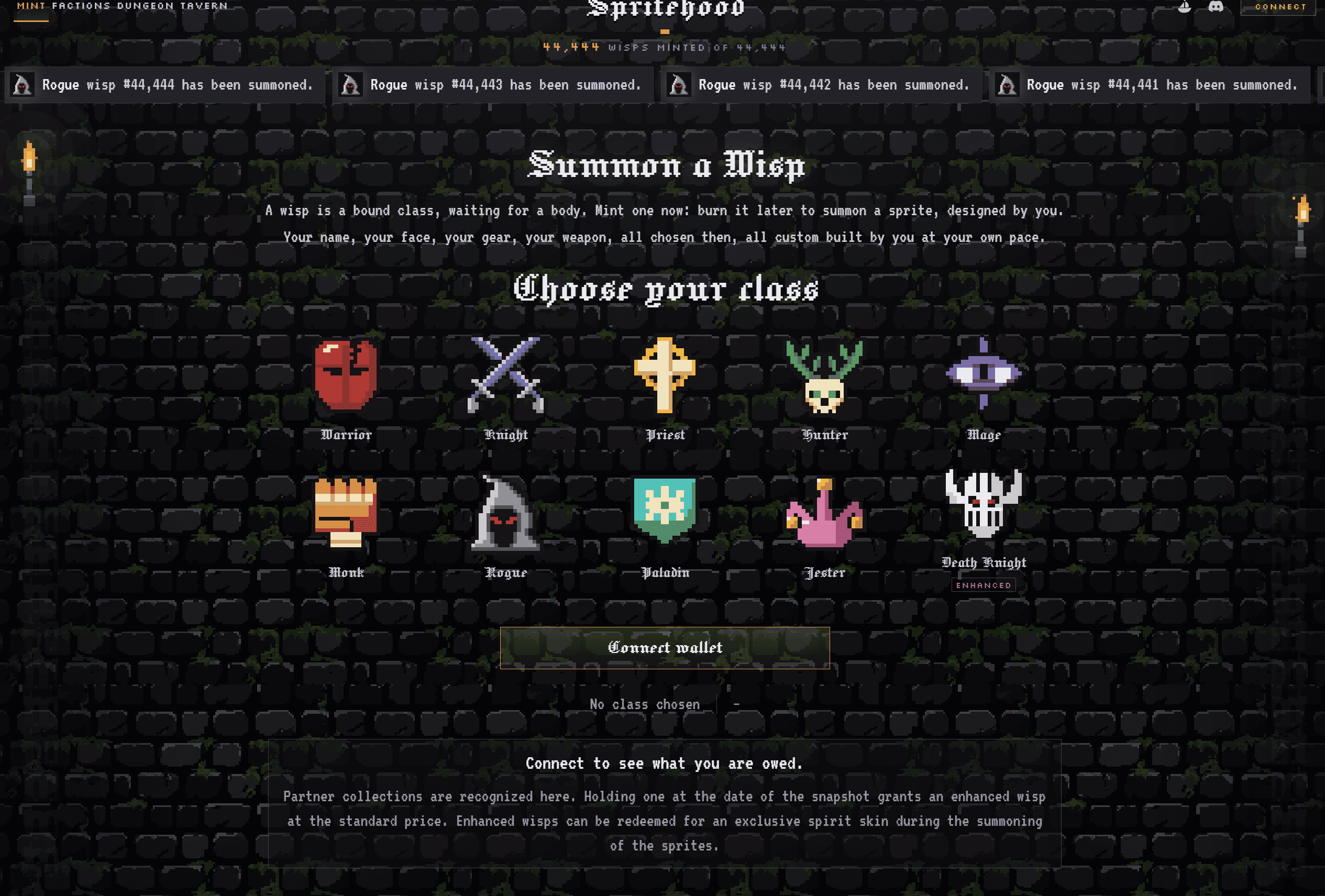
Spritehood is a fantasy, RPG-inspired NFT project built around customizable characters called sprites. Its first release was not a conventional finished PFP collection. Instead, collectors minted Wisps: tokens that represent a bound character class waiting for a body.
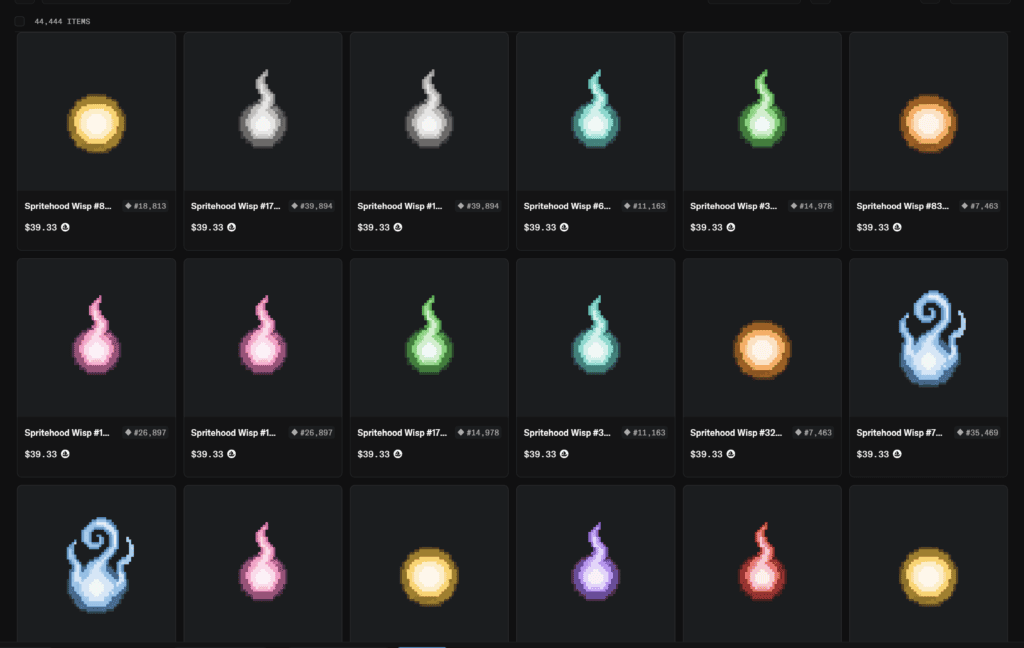
According to the project’s mint page, all 44,444 Wisps were summoned. Each Wisp belongs to one of ten classes: Warrior, Knight, Priest, Hunter, Mage, Monk, Rogue, Paladin, Jester, or Death Knight. The live summoning feed gave the release the energy of a game launch, announcing each new class as the collection moved toward its final mint.
The Wisp is only the beginning. A holder can later burn it to summon a sprite and choose the character’s name, face, gear, and weapon. The project describes the final sprite as custom-built by its owner, at the owner’s own pace. That structure transforms the mint from a one-time reveal into a longer creative process in which collectors participate in building their identities.
Spritehood also recognizes selected partner collections. Wallets that held an eligible collection at the project’s snapshot could mint an enhanced Wisp at the standard price. Enhanced Wisps can later be redeemed for an exclusive spirit skin while summoning a sprite. Beyond the mint, the project’s website introduces Factions, a Dungeon, and a Tavern—world-building elements that suggest the team is aiming for a participatory fantasy universe rather than a static gallery of profile pictures.
The collection can also be viewed on OpenSea, while project creator ColeThereum is documenting the rollout publicly.
Why Launching on Robinhood Chain Matters
Spritehood is also notable for where it launched. The project is built on Robinhood Chain, Robinhood’s new permissionless Ethereum Layer 2. The network was developed using Arbitrum’s Layer 2 infrastructure, is compatible with standard Ethereum tools, uses ETH as its native gas token, and inherits security from Ethereum.
Robinhood launched the chain’s public mainnet in July 2026 with an initial emphasis on onchain financial services and tokenized real-world assets. Spritehood demonstrates that the network may support something broader: consumer crypto, digital identity, games, art, and online communities. A 44,444-item NFT mint gives the young chain a highly visible cultural use case at a moment when most of its public narrative has centered on finance.
That combination is worth watching. Robinhood already has a massive mainstream financial brand, while its chain gives developers an open, EVM-compatible environment connected to the Ethereum ecosystem. That does not mean every Robinhood user will suddenly become an NFT collector, nor does launching on Robinhood Chain imply an endorsement from Robinhood. It does, however, put Spritehood near infrastructure designed to make onchain participation more familiar to a much larger potential audience.
For NFTs, distribution has always been one of the hardest problems. The technology worked long before the experience felt accessible. Projects launching on chains associated with recognizable consumer platforms could help narrow that gap. Spritehood’s sellout is an early signal—not definitive proof—that collectible culture can find traction on Robinhood’s new Ethereum Layer 2.
The NFT Market Needs Something People Want to Participate In
For years, the NFT market has been waiting for a catalyst. We have seen impressive technological improvements, stronger infrastructure, lower transaction costs, and thoughtful work from committed artists. What has been harder to recover is the feeling that made people want to participate.
NFTs were never powered by technology alone. They grew because collecting felt alive. People discovered characters, joined communities, traded assets, formed friendships, learned about artists, and participated in a shared cultural moment. The best projects turned passive observers into active members of an ecosystem.
Spritehood appears to be tapping into some of that old energy. Cole has openly leaned into tactics associated with the 2021 era—including the humble NFT giveaway—but nostalgia alone is not the important signal. The signal is that people are once again debating a new NFT-native project, watching its development, sharing its artwork, and wondering what might happen next.
After a long period dominated by apathy, any genuine curiosity is meaningful.
Large Projects Do Not Necessarily Take Capital Away From Artists
One of the most common arguments against PFP and collectible projects is that they divert money away from “real art.” According to this view, every ETH spent on a speculative mint is ETH that could have supported an independent artist.
My experience was almost the opposite.
I was not a whale who entered the market with hundreds of ETH. I was a modest participant who bought into projects, made some good decisions, and earned enough ETH to begin collecting art seriously. Some of the capital I generated through larger projects eventually moved into the work of independent and emerging artists.
I know many other collectors whose stories followed a similar path.
They entered through an accessible PFP, a game, a collectible, or a community mint. They learned how wallets and marketplaces worked. They developed conviction, discovered generative art and one-of-one work, and eventually became patrons of artists they might never have encountered otherwise.
The speculative market did not simply extract value. In its healthier moments, it distributed capital and created collectors.
That distinction is important. A sustainable art ecosystem needs more than talented artists. It needs an active collector base with disposable capital, cultural curiosity, and the confidence to buy work. Major projects can act as the front door to that ecosystem, especially for people who do not initially identify as traditional art collectors.
Attention, Liquidity, and Patronage Form a Flywheel
The relationship between large projects and independent artists is not a zero-sum game. When the market functions properly, it behaves more like a flywheel:
- A compelling project attracts attention.
- Attention brings new participants into the market.
- Participation creates activity and liquidity.
- Successful participants gain capital and confidence.
- Some of that capital flows into artists, galleries, experiments, and new creative projects.
This flow was visible during the last cycle. It was imperfect and often unfair, but it was real. Many artists found collectors because those collectors first arrived through CryptoPunks, Bored Ape Yacht Club, Art Blocks, Pudgy Penguins, Cool Cats, or dozens of smaller projects.
When collectible markets disappear, independent artists do not necessarily inherit all the capital that would have gone into them. Often, the capital leaves NFTs entirely. The collector buys memecoins, trades tokens, purchases physical collectibles, or simply returns to traditional investments.
Artists benefit from having more people emotionally and financially invested in the broader NFT ecosystem.
A Revival Cannot Be a Repeat of 2021
Rooting for Spritehood does not mean giving its team—or any team—a free pass.
The market cannot afford another cycle built on vague promises, manufactured scarcity, undisclosed incentives, and endless extraction. Founders must communicate clearly. Buyers must understand what they are purchasing. Communities must stop confusing price appreciation with guaranteed execution. Influence and promotion should be transparent.
Most importantly, projects need to recognize that trust is now part of the product.
The next NFT cycle will not succeed by pretending the last one never happened. It must preserve the creativity, fun, and open participation of 2021 while rejecting the worst behaviors that grew alongside them. That means healthier expectations, better accountability, more sustainable economics, and fewer promises designed solely to sell the next mint.
Optimism and scrutiny are not opposing positions. We can hope Spritehood succeeds while judging it by what the team actually delivers.
Spritehood Does Not Need to Save NFTs
Spritehood may succeed, or it may fail. It is far too early to present it as proof of a wider NFT recovery. One popular collection cannot repair years of damaged trust, revive every marketplace, or solve the economic challenges confronting digital artists.
But market recoveries rarely begin with universal confidence. They begin with isolated pockets of energy: a project people enjoy, a new group of collectors arriving, an artist breaking through, or a community remembering why this technology felt exciting in the first place.
Spritehood could become one of those pockets.
The most important outcome would not be a high floor price or a profitable mint. It would be the creation of more active participants who remain in the ecosystem after the initial excitement fades. If some of those people become collectors, support independent artists, commission work, attend exhibitions, or fund the next creative experiment, the effects will extend far beyond Spritehood itself.
We do not need another reckless NFT cycle. We need a healthier one: fun projects that attract attention, transparent teams that earn trust, collectors who build capital, and more of that capital circulating toward artists.
If Spritehood can help restart that flywheel, I am rooting for it—and artists should be rooting for it too.
TL;DR
Spritehood sold out 44,444 class-based Wisps on Robinhood Chain, a new Ethereum Layer 2 built with Arbitrum technology and powered by ETH. Collectors can later burn their Wisps to create personalized sprites, giving the project a participatory identity beyond a standard PFP reveal. Skepticism around creator Cole Villemain is warranted, but large projects can onboard participants, distribute capital, and turn modest traders into meaningful collectors of independent art. Spritehood will not revive NFTs on its own, but its sellout, customization model, and launch on new consumer-facing infrastructure are welcome signs of life.
