


Should Bitcoin [BTC] have a place in your portfolio? Some investors say it helps spread out risk. Others think it just adds more of it.
The 60/40 portfolio is now 60/20/20
The latest take on this comes from Jurrien Timmer, Global Macro Director at Fidelity.
In a post on X, he said the old 60/40 portfolio, 60% stocks and 40% bonds, has had its day. What’s replaced it is a 60/20/20 split: 60% equities, 20% bonds, and 20% alternative assets.
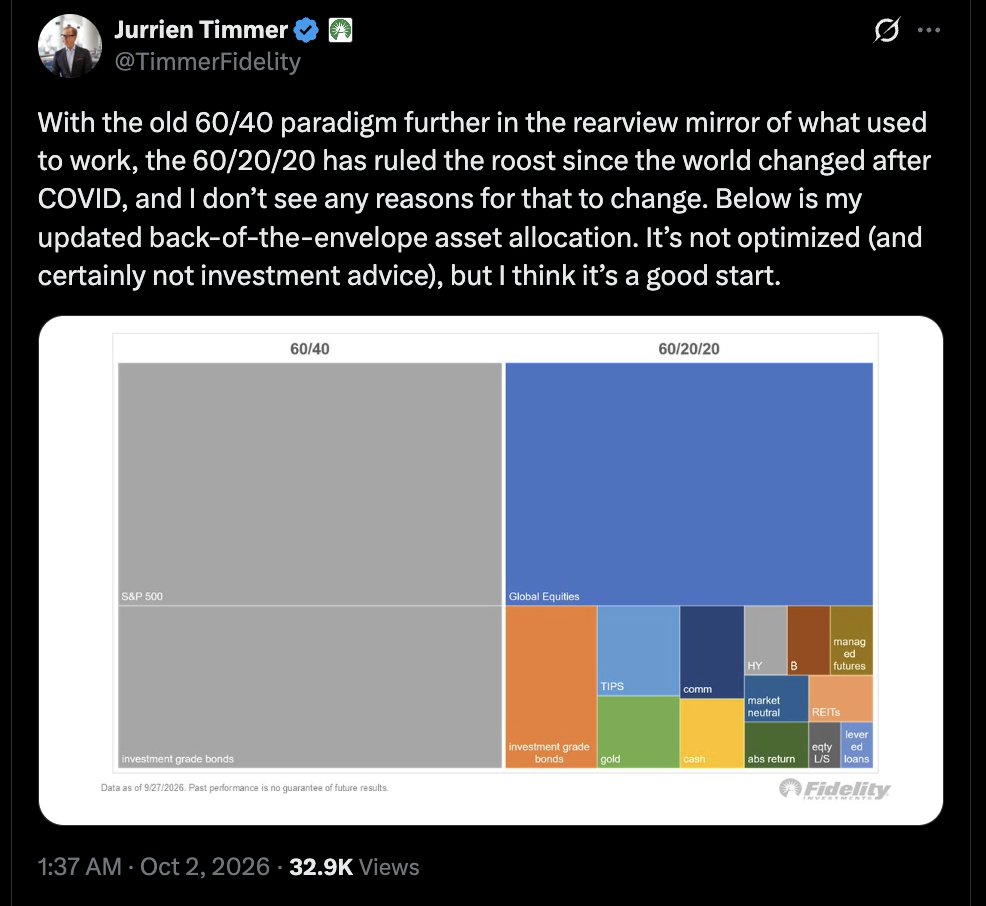
Timmer says this change kicked in after the pandemic, and he doesn’t see a reason to switch things up right now. The 60/40 setup has been the default for decades, so setting aside a fifth of a portfolio for alternatives is no small thing.
Eventually, Bitcoin will come up in the conversation.
Where BTC fits in this new plan
In Timmer’s updated model, 20% goes to alternative assets. That covers gold, commodities, cash, Bitcoin, REITs, and managed futures.
So why talk about BTC?
BTC’s correlation with the S&P 500 is at 30%, and it has no correlation with US Treasury bonds. Bitcoin doesn’t always move in step with stocks and bonds; exactly what you want from something meant to diversify.
That said, Timmer was clear that this isn’t an optimized portfolio. He called it a rough example of how assets could be split and said it shouldn’t be taken as investment advice.
Notably, this isn’t the first time he’s been upbeat on Bitcoin, either. In an earlier analysis, with the power law model, he predicted a BTC price of $300K by 2029.
AMBCrypto previously reported that Timmer spotted BTC forming a double bottom on the weekly charts. A weekly close above $82K would complete the pattern and clear the way to $100K, a potential 24% upside.
That $82K level mattered on-chain too, since it was also the average cost basis of US spot BTC ETFs.
Final Summary
- Fidelity’s Jurrien Timmer says the 60/40 portfolio is now 60/20/20; Bitcoin is in the 20% alternatives bucket.
- BTC’s minimal correlation with Treasuries makes it a diversifier.
