


Zcash developers are moving toward a new auditable shielded pool called Ironwood after last week’s Orchard vulnerability disclosure reignited concerns around hidden inflation risks and unverifiable supply integrity.
In a June 6 proposal, Zcash Open Development Lab [ZODL] outlined plans for a new shielded pool. It is designed to restore publicly verifiable supply accounting while preserving user privacy.
The proposal followed the June 5 disclosure that a critical flaw inside Zcash’s Orchard shielded pool could have theoretically enabled unlimited undetectable counterfeit ZEC before an emergency fix was deployed.
Developers stressed at the time that there was no evidence the flaw had ever been exploited and that circulating supply had not changed.
Attention around Orchard intensified again on June 11 after Arkham flagged a withdrawal representing roughly 1% of all ZEC held inside the shielded pool.
Ironwood aims to restore auditable supply integrity
The proposed Ironwood upgrade introduces a “turnstile” accounting mechanism designed to make Zcash’s circulating supply publicly auditable again.
Under the proposal, the existing Orchard pool would stop accepting new deposits and internal transfers. Funds could only move forward through the turnstile before entering Ironwood.
Because the mechanism rejects any attempt to withdraw more ZEC than was originally deposited into the migration process, the ecosystem says users would gain a trustless guarantee that circulating supply remains accurate.
“The total supply moved from Orchard to Ironwood will be verified by a turnstile, allowing anyone to audit Zcash’s circulating supply,” ZODL wrote in the proposal.
The ecosystem also said Ironwood would undergo additional independent audits and formal verification reviews to rule out future soundness issues.
The upgrade is currently targeting activation in late July 2026, following the planned deprecation of zcashd support.
Arkham withdrawal revives focus on Orchard balances
The Ironwood proposal returned to the spotlight Thursday after Arkham highlighted a large Orchard withdrawal on-chain.
Arkham said Orchard still theoretically holds around 3.88 million ZEC, worth approximately $1.65 billion. However, the platform acknowledged shielded balances cannot be independently verified.
The transaction itself does not prove counterfeit ZEC entered circulation or that the Orchard flaw was exploited before remediation.
However, the movement attracted attention. This was because the original disclosure acknowledged that there is no way to determine if inflation occurred before the patch.
That uncertainty has become central to the broader debate surrounding privacy-preserving cryptocurrency systems.
ZEC stabilizes after sharp post-disclosure selloff
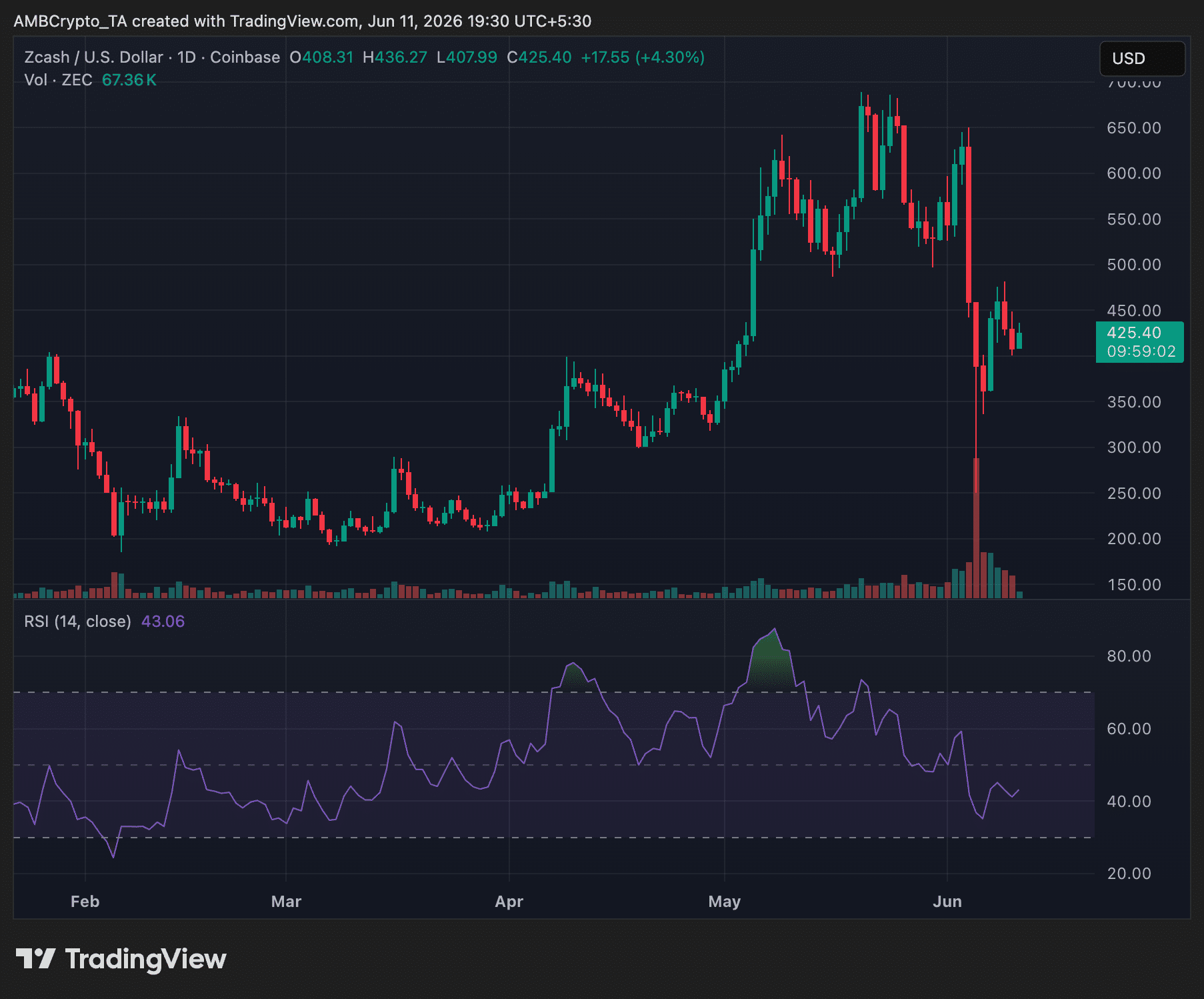
ZEC price action has also shifted notably since the initial Orchard disclosure.
After experiencing a sharp selloff immediately following the June 5 announcement, ZEC later stabilized as traders reassessed the long-term implications of the flaw and the ecosystem’s proposed response.
The rebound suggests markets may be treating the issue as a contained technical vulnerability rather than evidence of a catastrophic supply failure. At the time of this writing, it was trading with an over 4% gain, around $425.
The proposed Ironwood migration aims to restore long-term confidence in Zcash’s privacy infrastructure while preserving shielded transaction functionality.
Final Summary
- Zcash developers proposed the auditable Ironwood shielded pool after last week’s Orchard vulnerability disclosure.
- Renewed scrutiny around large Orchard withdrawals has intensified focus on Zcash’s efforts to restore publicly verifiable supply integrity.
