


For high-net-worth individuals and privacy-conscious users, the primary challenge of 2026 isn’t just spending liquidity—it’s managing the attack surface created by direct merchant interactions. Every time a primary hardware wallet interacts with a third-party merchant processor, metadata is exchanged. This includes IP addresses, browser fingerprints, and transaction paths that can link a high-value wallet to a physical identity.
The use of digital vouchers acts as a strategic buffer. By using an intermediary layer to convert crypto into merchant-specific credits, users effectively decouple their on-chain identity from their consumption habits. This guide evaluates the top five platforms providing these rails, focusing on data retention, refund protocols for delayed blockchain confirmations, and the reliability of their delivery systems.
Why buy gift cards with cryptocurrency?
The pivot toward gift cards is less about convenience and more about risk mitigation. Direct crypto-to-merchant payments often require extensive KYC (Know Your Customer) documentation for even small purchases, creating a centralized honeypot of personal data. By contrast, purchasing a voucher allows for a single, controlled point of exit.
From a technical standpoint, gift cards solve the finality friction inherent in Proof-of-Work or high-latency networks. A merchant waiting for six Bitcoin confirmations before releasing a product is a logistical bottleneck. Using a specialized marketplace allows the user to absorb that latency at the point of voucher purchase, resulting in a pre-funded credit that works instantly at the point of sale. Furthermore, it limits exposure to dusting attacks and address poisoning by keeping merchant interactions entirely off-chain.
1. CoinsBee — Best overall crypto gift card marketplace
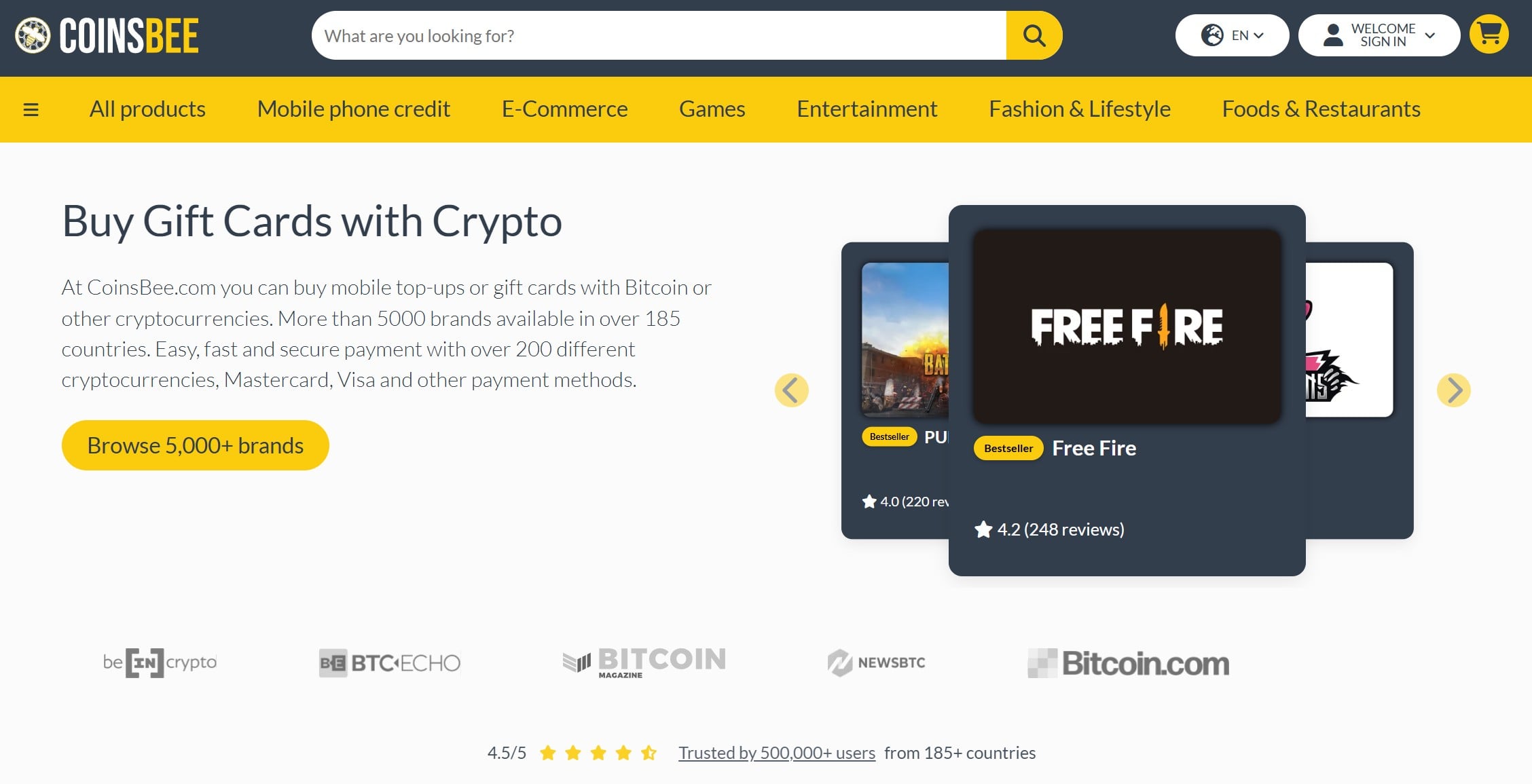
CoinsBee maintains a dominant position in the 2026 market due to its infrastructure for handling high-volume, cross-border transactions without unnecessary data collection. For users who need to buy gift cards with Bitcoin or stablecoins, the platform operates as a liquidity bridge across 185 countries, supporting over 200 different tokens.
The platform’s technical utility lies in its handling of failed confirmations. In the event of a network spike where a transaction fee is set too low and the blockchain confirmation arrives after the merchant’s window expires, CoinsBee utilizes an automated refund protocol or manual re-validation rather than flagging the funds as lost.
- Brand Inventory: Covers approximately 5,000 brands, including major regional retailers in Europe, Asia, and North America.
- Data Retention: The platform allows for transactions under $1,000 without requiring a full account setup, minimizing the PII (Personally Identifiable Information) stored on their servers.
- Sector Breadth: While heavy on gaming (Steam, PlayStation) and retail (Amazon, Zalando), it also supports niche sectors like mobile top-ups and regional grocery chains.
2. BitRefill

BitRefill functions as a circular economy tool, particularly for users utilizing the Lightning Network. Their focus is on reducing the cost of small-value transactions. Their delivery system is highly optimized for speed; however, their Refill account system encourages users to keep balances on their platform, which introduces a small degree of custodial risk that purists might avoid.
- Lightning Integration: One of the most mature implementations of Layer-2 Bitcoin payments, reducing transaction fees to near zero.
- Global Reach: Strong presence in emerging markets, specifically for prepaid mobile data and utility bills.
- Security: Offers two-factor authentication (2FA) for account holders, though the reliance on an internal balance system requires careful management by the user.
3. GiftChill

GiftChill has carved out a niche by supporting a specific subset of tokens that larger marketplaces often ignore, including various DeFi-native assets. The platform is frequently used by those looking to off-ramp assets from smaller ecosystems without first swapping to BTC or ETH, which would trigger additional taxable events or exchange fees.
- Token Support: Prioritizes high-speed, low-fee networks like Solana and Polygon.
- Operational Transparency: The platform provides clear indicators of stock levels, preventing the common issue of ghost stock where a user pays for a code that is actually out of inventory.
- Refund Policy: Their protocol for underpayments—often caused by exchange withdrawal fees being deducted from the total—is transparent, usually involving a credit to the user’s email-linked account.
4. CryptoRefills

Based in Europe, CryptoRefills is governed by stricter GDPR standards, which reflects in their data handling policies. They have focused heavily on the “shopping” and “travel” categories, making them a preferred choice for users who are funding nomadic lifestyles or high-spend retail habits entirely via crypto.
- L2 Support: Robust support for Arbitrum and Optimism, catering to the Ethereum-centric user base.
- Loyalty Mechanics: While they offer a points system, it is designed in a way that doesn’t require excessive tracking, though it does necessitate a persistent account.
- Enterprise Integration: Their API is often used by other wallets, suggesting a high level of back-end stability and code audit frequency.
5. Bidali

Bidali positions itself as a more “institutional-grade” gateway. Their focus is on the reliability of the merchant connection. They work directly with brand partners rather than using secondary markets to source codes, which significantly reduces the risk of deactivated or already used gift cards.
- Direct Sourcing: High reliability for high-value cards (e.g., $500+).
- Wallet Integration: Many non-custodial wallets use Bidali as their native spend feature, allowing users to purchase vouchers without leaving their wallet interface.
- Strict Compliance: They maintain a higher threshold for KYC than some competitors, which may be a deterrent for those seeking absolute anonymity but provides a higher level of legal recourse for large transactions.
Comparison: Cryptocurrencies, brands, countries and product selection
When evaluating these platforms, the choice often comes down to the specific friction points of the user’s preferred chain.
| Platform | Primary Strength | Supported Tokens | Geo-Focus |
|---|---|---|---|
| CoinsBee | Inventory Depth | 200+ (BTC, ETH, LTC, etc.) | Global (185+ countries) |
| BitRefill | L2/Lightning Speed | BTC, ETH, USDT, Dash | Global / Emerging Markets |
| GiftChill | Asset Diversity | BTC, BUSD, Doge, SOL | US & Europe |
| CryptoRefills | L2 Optimization | ETH (L2), BTC, USDC | Europe |
| Bidali | Code Reliability | BTC, ETH, ERC-20 | North America |
Users holding stablecoins on Layer-2 networks should prioritize CryptoRefills or CoinsBee to avoid the high gas fees associated with Ethereum Mainnet. Conversely, those operating within the Bitcoin ecosystem will find the Lightning integration at BitRefill most efficient for daily expenses.
What to check before buying crypto gift cards
The 2026 threat landscape is dominated by sophisticated phishing and “middle-in-the-middle” attacks. Before committing funds to any voucher platform, a technical audit of the session is mandatory.
1. Verification of the TLS Certificate and Onion Headers Do not rely on the lock icon alone. Check the certificate issuer and the validity period. Many high-end phishing sites now use automated Let’s Encrypt certificates to mimic legitimacy. If using a Tor-enabled browser, ensure the .onion address matches the official documentation provided by the platform’s verified social channels.
2. Understanding the “Gas-Inclusive” Total A common point of failure is the underpayment error. When sending from an exchange, the exchange often deducts the withdrawal fee from the sent amount. If the marketplace requires exactly 0.005 BTC and they receive 0.0049 BTC, the voucher delivery will stall. Always use a non-custodial wallet where you can set the fee independently of the principal amount.
3. Data Retention and Email Masking Even if a platform claims No KYC, they still require an email address to deliver the digital code. This email is a link to your identity. High-security users should utilize an aliasing service (like SimpleLogin or AnonAddy) or a dedicated PGP-encrypted mail provider. This ensures that if the marketplace suffers a data breach, your primary email address isn’t leaked alongside your crypto spending history.
4. The “Second-Hand” Risk Avoid marketplaces that operate as P2P (Peer-to-Peer) gift card exchanges. These sites often host codes purchased with stolen credit cards. When the fraud is eventually detected by the merchant, the gift card balance is voided, leaving the crypto spender with a $0 balance and no recourse. Stick to platforms that source codes directly from authorized distributors or the brands themselves.
Conclusion
The transition from holding crypto to spending it involves navigating a minefield of privacy leaks and technical hurdles. The platforms mentioned above provide the necessary infrastructure to bridge the gap between digital assets and real-world utility without requiring users to expose their entire financial history to every coffee shop or online retailer they visit. By selecting a provider based on their handling of network latency and data privacy, users can maintain their security posture while accessing the global retail market.
FAQs
Several platforms — including CoinsBee, BitRefill, and Bidali — offer the option to purchase gift cards for various brands using Bitcoin. The general workflow involves selecting a card denomination, sending BTC to a provided address, and receiving a digital code via email or on-screen once the payment is confirmed.
It depends on the platform and the transaction amount. CoinsBee, for example, allows purchases under $1,000 without a full account setup. BitRefill and GiftChill also offer low-friction options. However, platforms like Bidali maintain stricter KYC thresholds, especially for high-value cards above $500.
Different platforms have different approaches to delayed confirmations. CoinsBee, for instance, states that it uses an automated refund protocol or manual re-validation. Other platforms may credit the user’s account or require a support ticket. Setting an adequate network fee when sending from a non-custodial wallet can help reduce the likelihood of confirmation delays.
Key considerations include verifying that the platform sources codes from authorized distributors rather than peer-to-peer resellers, checking the site’s TLS certificate before submitting a transaction, using an email alias to limit personal data exposure, and sending payments from a non-custodial wallet rather than an exchange (which may deduct withdrawal fees from the total, causing underpayment errors). Users should conduct their own due diligence before transacting on any platform.
For Bitcoin users, BitRefill’s Lightning Network integration offers near-zero transaction fees. For Ethereum Layer-2 users, CryptoRefills and CoinsBee avoid mainnet gas costs. Most platforms on this list also accept stablecoins like USDT, USDC, and DAI — CoinsBee supports over 200 tokens — which eliminates the price volatility risk that comes with paying in BTC or ETH.
