

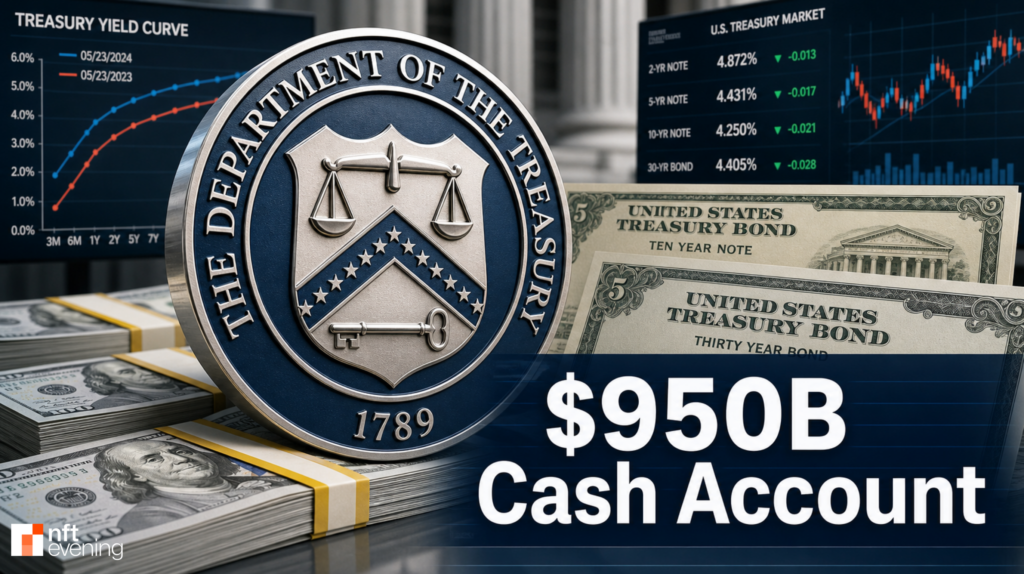
The U.S. Department of the Treasury is considering using a portion of the Treasury General Account (TGA), the government’s nearly $950 billion cash account at the Federal Reserve, to support its recently expanded bond buyback program. CNBC quoted two senior Treasury officials as saying that this option could boost resources for efforts to stabilize the long-end Treasury market amid persistently high yields.
Treasury Looks to Its Cash Account
These officials said the TGA is being viewed as a potential source of funds for the recently expanded government bond buyback program. They have not yet specified whether the Treasury will use the account, the size of any such drawdowns, or the timing of an announcement if it implements the plan.
Previously, the more widely watched option was issuing additional short-term Treasury bills to fund buybacks of long-term debt. Treasury Secretary Scott Bessent had described this approach as a form of “Treasury Twist,” indicating that the focus is on shifting the debt maturity structure rather than expanding the balance sheet like the Fed’s asset purchase programs.
If the TGA is used, the Treasury could draw down a portion of its cash holdings at the Fed to buy back bonds, rather than immediately issuing additional bills. According to the Fed’s H.4.1 data, the TGA stood at $953.6 billion as of August 19, close to the assumed cash balance of $950 billion for the end of September in the Treasury’s latest quarterly borrowing plan.

U.S. Treasury General Account, Week Ended Aug. 19, 2026. Source: The Federal Reserve
Buyback Program Is Already Being Expanded
The potential use of the TGA was mentioned shortly after the Treasury expanded its long-term bond buyback program. On August 19, the agency announced an increase in the size of liquidity-support buyback operations in the 10-to-20-year and 20-to-30-year maturity buckets from up to $2 billion to at least $4 billion per session. Purchases at the new scale are scheduled to begin on September 9 and run through November 4, 2026.
This program does not target the entire Treasury market as the Fed did during its quantitative easing (QE) rounds. According to TreasuryDirect, Treasury buybacks focus on previously issued nominal coupon bonds and TIPS, excluding Treasury bills, floating-rate notes, or STRIPS. The repurchased securities will be retired, thereby reducing the amount of older outstanding bonds in selected maturity buckets.
In its plan announced in early August, the Treasury stated it could purchase up to $38 billion in off-the-run securities for liquidity support, alongside up to $25 billion in the 1-month to 2-year maturity range for cash management purposes. While this size remains small relative to the broader Treasury market, raising per-session purchase amounts at the long end marks a notable expansion in efforts to improve liquidity for older bond issues.
Why TGA Funding Matters for Markets
Treasury yields fell after the possibility of using the TGA to fund buybacks was revealed: the 10-year yield dropped about 3 – 4 basis points to the 4.69% – 4.71% range in Monday’s session, while the 30-year yield edged back to around 5.19% – 5.25%. The decline was modest, but it indicates that investors are paying attention to the possibility of the Treasury having additional resources to support the long end.
Liquidity flows from the TGA could enter the financial system and support bank reserves in the short term, rather than being immediately neutralized by new debt issuance. The ultimate impact will depend on the size of the TGA drawdown, the pace of repurchases, and how the Treasury subsequently rebuilds its cash balance.
If the Treasury quickly replenishes the TGA through bill or coupon debt issuance, the liquidity-support effect may be short-lived. If the cash balance is maintained at a lower level for a period of time, the impact on bank reserves and long-end demand could be more pronounced, though it would also raise questions regarding the government’s cash buffer.
Fiscal Pressures Keep Investors Wary
Buybacks could help improve liquidity in older bonds, but the proposal comes amid ongoing heavy fiscal pressures in the U.S. The Congressional Budget Office (CBO) projects a federal budget deficit of approximately $1.9 trillion for fiscal year 2026, with net interest costs exceeding $1 trillion, according to the agency’s 2026 – 2036 budget outlook.
With bond supply remaining large, the impact of buybacks may be limited. The program could help the Treasury market function more smoothly, but long-term yields remain influenced by inflation expectations, the term premium, the Fed’s outlook, and confidence in the U.S. fiscal trajectory.
According to the officials, a partial drawdown of the TGA would not create immediate issues, as the next debt ceiling constraint is projected to fall between winter and early spring. Rebuilding the TGA back toward current levels later on could still require additional debt issuance.
What to Watch Next
The market will await an official announcement from the Treasury regarding whether the TGA will be used to fund buybacks. Updated buyback schedules, purchase sizes starting September 9, weekly TGA data in the Fed’s H.4.1 report, and bill issuance volumes will be key indicators in the coming weeks.
The next key milestone is the Quarterly Refunding on November 4, 2026, when the Treasury may update how it balances buybacks, new debt issuance, and maintaining its cash balance. Movements in 10-year and 30-year yields will also indicate how the market evaluates the program’s scale and funding sources.
