

Key Takeaways
- Strategy and Michael Saylor publicly endorsed the CLARITY Act.
- The Senate proposal divides crypto oversight between two regulators.
- The measure gained backing as institutional interest in crypto grows.
Strategy and Saylor Join the CLARITY Act Campaign
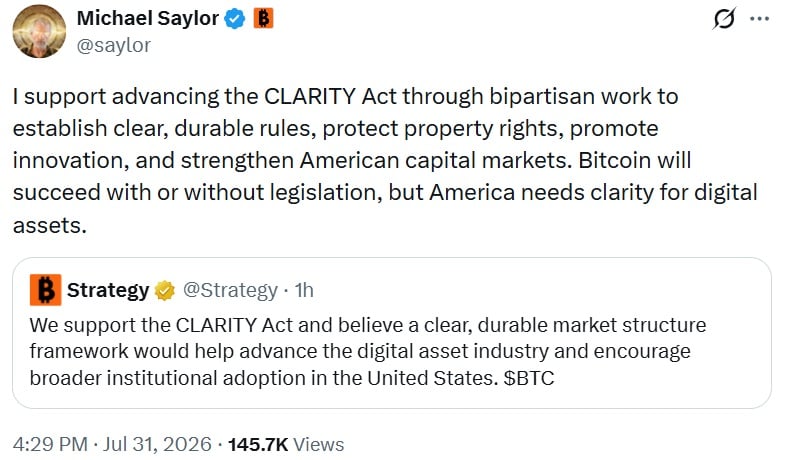
Strategy Inc. (Nasdaq: MSTR) announced its support for the Digital Asset Market Clarity Act on July 31, adding the world’s largest corporate bitcoin holder to the legislative campaign. The company presented the bill as a bipartisan framework supporting market expansion, institutional participation, consumer protection, and individual digital asset ownership.
Strategy declared:
“We support the bipartisan CLARITY Act. It establishes a clear framework for the growth of digital asset markets, accelerates institutional adoption, strengthens consumer protections, and safeguards the right of individuals to own and control their digital assets.”
Michael Saylor’s CLARITY Act endorsement adds one of the cryptocurrency industry’s most influential corporate voices to the campaign for market structure legislation. As executive chairman of the world’s largest corporate bitcoin holder, his support reflects growing institutional interest in establishing a durable regulatory framework for digital assets before broader adoption accelerates.
Saylor wrote:
“I support advancing the CLARITY Act through bipartisan work to establish clear, durable rules, protect property rights, promote innovation, and strengthen American capital markets. Bitcoin will succeed with or without legislation, but America needs clarity for digital assets.”
The endorsement comes as the Senate considers a market structure framework assigning responsibilities between the U.S. Securities and Exchange Commission (SEC) and Commodity Futures Trading Commission (CFTC), while establishing registration routes for exchanges, brokers, dealers, and custodians.
The Senate Banking Committee approved the measure by a 15-9 vote on May 14. U.S. Senator Cynthia Lummis (R-WY) released updated CLARITY Act text on July 22 as lawmakers prepared the measure for broader Senate consideration.
Strategy’s Bitcoin Strategy Extends Beyond Regulation
Strategy’s second-quarter results, released July 30, showed how bitcoin volatility continues shaping its finances, funding model, and broader capital markets strategy. The company reported an $8.22 billion net loss, including an $8.32 billion unrealized digital asset loss, while revenue rose 6.9% to $122.4 million. Strategy held 843,775 bitcoin and had raised $17.06 billion through at-the-market programs by July 26.
Beyond its quarterly results, Strategy continued building its bitcoin treasury through common shares, preferred securities, and other capital programs. That financing structure gives digital asset regulation direct relevance for shareholders, creditors, and institutions evaluating both the company’s bitcoin exposure and its ability to raise capital.
Saylor has also linked bitcoin’s long-term value to regulatory certainty and stable protocol rules. He projected bitcoin could rise 100-fold, explained when limited bitcoin sales could make financial sense, and rejected BIP 110 over concerns that a soft fork could weaken Bitcoin’s neutrality and predictability. Together, those positions show how Strategy’s policy priorities extend beyond legislation to the financial and technical rules surrounding bitcoin.
Political Pressure Builds as Senate Timeline Tightens
Supporters have intensified pressure on Congress, generating nearly 1 million contacts urging lawmakers to advance digital asset market structure legislation. That campaign has been reinforced by institutional arguments that clearer SEC and CFTC responsibilities could reduce uncertainty for developers, exchanges, custodians, investors, and token issuers.
Passage remains uncertain after Galaxy Research lowered its estimated enactment probability from 50% to 30%, citing unresolved disputes and difficult Senate vote requirements. At the same time, nearly 70% of surveyed cryptocurrency owners indicated that candidates’ digital asset positions could influence their midterm votes, increasing political pressure as the Senate’s legislative window narrows.
