


TLDR
- Brent crude fell over 6% to around $90.93 a barrel on Monday after the U.S. paused its bombing campaign against Iran
- Brent had briefly hit $100 a barrel last week as fighting spread to the Red Sea
- Washington paused strikes after 13 consecutive nights, saying it was giving diplomacy space
- Iran said it would suspend retaliatory attacks while the U.S. pause holds
- Shipping disruptions through the Strait of Hormuz and Bab el-Mandeb Strait continue despite the pause
Oil prices dropped sharply on Monday after the United States paused its military campaign against Iran, raising hopes for a return to diplomacy and easing the war premium that had pushed crude to $100 a barrel.
Brent crude fell more than 6% to $90.93 a barrel. West Texas Intermediate dropped 6.1% to $83.83 a barrel. Both contracts briefly fell below their key support levels before recovering slightly.
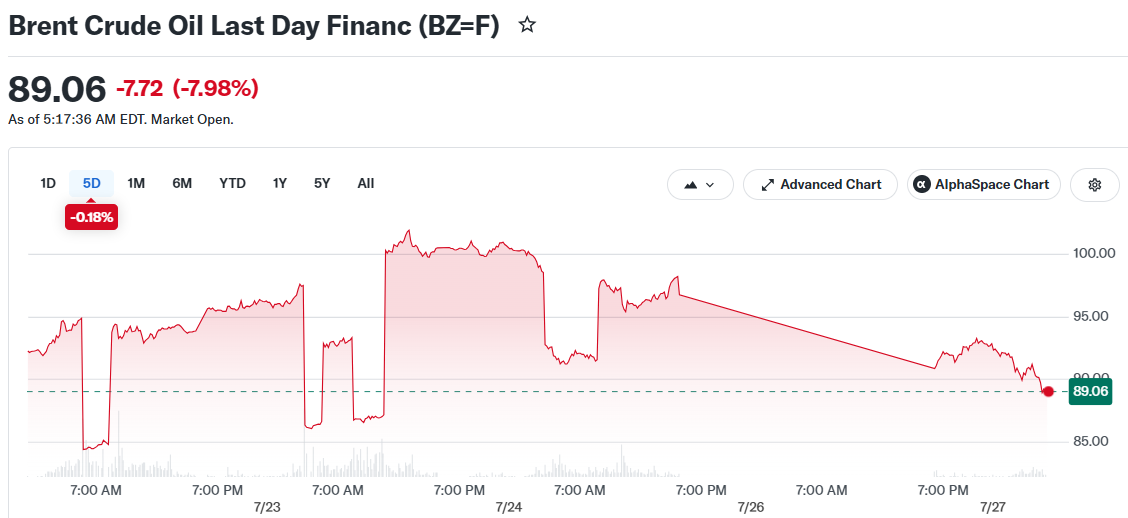
Last week, Brent broke back above $100 a barrel for the first time since May. The spike came after fighting between the U.S. and Iran expanded beyond the Strait of Hormuz into the Red Sea.
What Triggered the Sell-Off
Washington held off on further strikes after 13 consecutive nights of attacks on Iranian sites. Donald Trump’s UN envoy said the U.S. president was “giving talks some space.”
BREAKING: US oil prices crash over -8% after the US and Iran halt strikes amid reports of new negotiations. pic.twitter.com/TXVSNrZdqH
— The Kobeissi Letter (@KobeissiLetter) July 26, 2026
Iran responded by saying it would suspend retaliatory attacks on regional neighbours as long as the U.S. pause stayed in place. Both sides warned they could resume action if talks break down.
Iran also said it had made progress in discussions with Oman on managing safe passage through the Strait of Hormuz. Pakistan was reported to be looking at resuming U.S.-Iran peace talks, following a push from China.

Analysts at ING said Monday’s drop reflected how quickly markets had priced in the war premium, and how quickly they moved to unwind it once signs of de-escalation emerged.
National Australia Bank’s Sally Auld said it appeared oil above $100 a barrel was prompting both sides to step back. She noted that developments over the weekend added some credibility to that view.
Shipping Disruptions Still a Risk
Despite the pause in fighting, shipping through both key waterways remained disrupted. Fewer cargo vessels transited the Strait of Hormuz over the weekend. Traffic through the Bab el-Mandeb also slowed after Houthi attacks on Saudi oil facilities.
ANZ warned that the buffers absorbing these disruptions, including lower Chinese crude imports, emergency stock releases, and alternative Saudi export routes, are becoming stretched.
The bank said commercial inventories are tightening and strategic stockpiles are declining. That leaves the market exposed to a sharp rebound in prices if disruptions worsen.
ING cautioned it is too early to call the conflict over. Washington has not fully explained the reason for its pause, and both sides remain on alert.
The easing of oil prices also helped broader equity markets on Monday. Lower crude reduces inflation fears, which had raised concerns about further interest rate increases from the Federal Reserve. The Fed is set to meet this week, with most analysts expecting it to hold rates steady.
Stop guessing and start investing with confidence. KnockoutStocks gives you the AI insights, market intelligence, and stock research you need to spot opportunities, cut through the noise, and make smarter investment decisions — all in one powerful platform.
Sign up today and get 50% OFF full access to our premium stock picks.
Simply use coupon code SPECIAL50 at checkout to claim your exclusive discount.

