


TLDR
- NEAR Intents has processed over $23 billion in volume across 30+ blockchains
- NEAR’s DeFi activity remains small compared to Ethereum, Solana, and BNB Chain
- Annual token issuance has been cut from 5% to around 2.5%
- The network earns relatively low daily fees, meaning token value relies on future growth
- Value captured by the NEAR token itself may not match the growth of its products
NEAR Protocol is a proof-of-stake blockchain built for smart contracts and decentralized apps. It was founded by Illia Polosukhin and Alexander Skidanov, both engineers with backgrounds in AI and distributed systems.
The project’s current focus is “chain abstraction.” The goal is to let users interact across multiple blockchains without needing to manage bridges, gas tokens, or separate wallets. NEAR handles those details in the background.
This gives NEAR a clearer identity than many Layer 1 blockchains that compete mainly on speed or low fees.
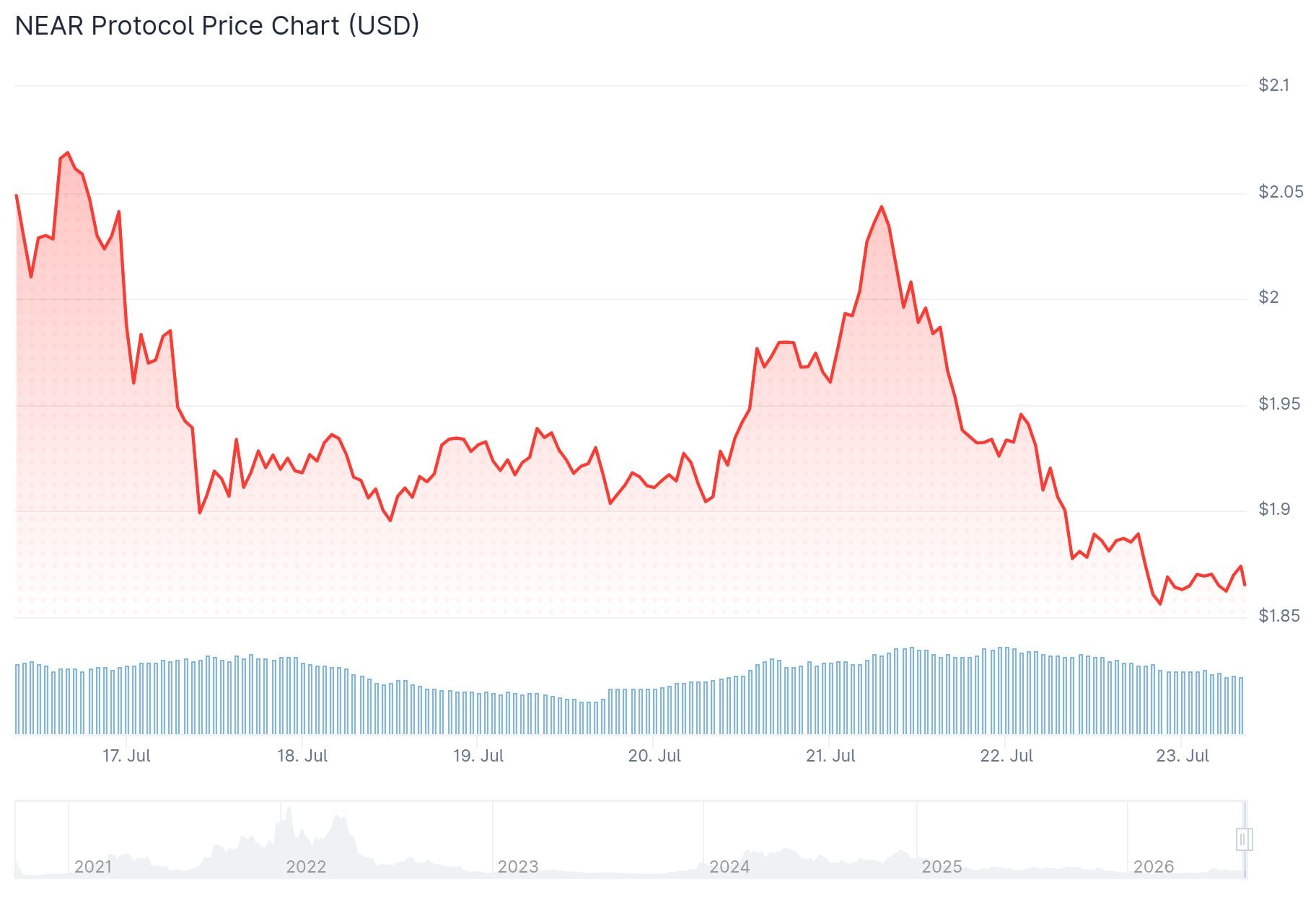
The TD Sequential called the last move on $NEAR.
A sell signal on July 21 was followed by an 8.34% decline. Now, the indicator has flipped to a buy signal, pointing to a potential rebound. pic.twitter.com/VK5bffMLaL
— Ali Charts (@alicharts) July 23, 2026
The strongest part of NEAR’s current story is NEAR Intents. It lets users say what outcome they want — for example, swapping a token on Ethereum for one on Solana — and market makers compete to complete the trade at the best price.
NEAR says Intents has handled more than $23 billion in total volume. It works across more than 30 blockchains, supports over 100 assets, and connects with major wallets and crypto services.
Those numbers show real usage, which is a positive sign in a market where many projects are still mostly promises.

Fee Revenue Still Lags Behind Valuation
NEAR’s base network processes hundreds of thousands of transactions daily and has tens of thousands of active users. But its DeFi market is much smaller than Ethereum, Solana, or BNB Chain.
Total value locked and stablecoin supply remain a small fraction of NEAR’s multi-billion dollar market cap. Daily transaction fees are also low, meaning the token’s current price is based mostly on expected future growth.
This is common for developing blockchains, but it means NEAR still has a lot to prove.
On tokenomics, NEAR has made progress. Annual issuance has dropped from 5% to around 2.5% of total supply. A portion of fees is also burned, which helps offset inflation.
But the network is not yet generating enough fees for that burning to make a real difference. Holders who don’t stake face gradual dilution as new tokens enter circulation.
The Value-Capture Gap
The bigger question is whether NEAR’s product growth translates into token demand.
NEAR Intents can scale without creating equal demand for NEAR. Gas fees on NEAR are very low by design, and other fees may go to partners, market makers, or ecosystem funds rather than to token holders.
That creates a gap between product success and token value. The investment case would improve if more fees were directed toward buying, burning, or staking NEAR in a clear and consistent way.
As of now, NEAR processes $23 billion in cross-chain volume through Intents while its DeFi total value locked stays a fraction of its market cap.

