

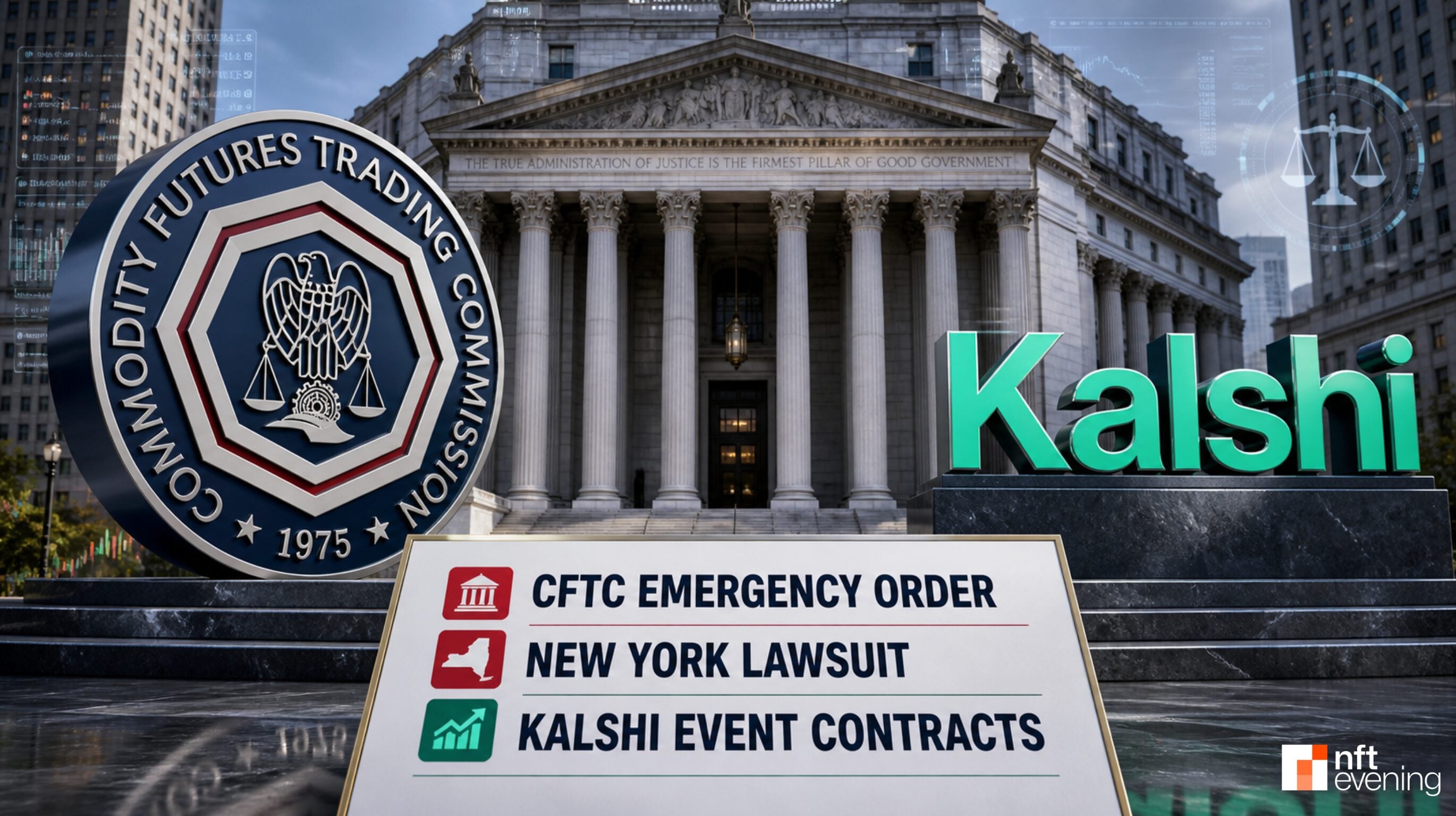
On August 11, in Washington, the U.S. Commodity Futures Trading Commission (CFTC) exercised its emergency authority to order KalshiEX to continue operating in accordance with the core principles of the Commodity Exchange Act, after the prediction market exchange reported a “market emergency” related to a new lawsuit from New York. The move puts the CFTC in more confrontation with New York Attorney General Letitia James, who is seeking to block Kalshi’s event contract operations through state court.
The case heightens the legal battle surrounding prediction markets. Kalshi argues that event contracts are federally regulated derivatives, while New York views them as unauthorized gambling. The dispute will not only determine Kalshi’s future in New York, but could also shape how the U.S. regulates prediction markets nationwide.
New York Seeks Nationwide Ban
New York filed a lawsuit against Kalshi in state court in Manhattan on July 31, targeting the company’s event contracts segment. These are contracts that allow users to trade based on the outcomes of future events, ranging from sports and politics to entertainment. According to the state’s argument, users are placing money on uncertain outcomes, so these products should be considered gambling subject to New York gaming law.
In the lawsuit, New York is not just seeking to block Kalshi within state borders. According to the CFTC press release, the state is also seeking a temporary injunction preventing Kalshi from offering all event contracts nationwide. According to the CFTC, New York is also demanding more than $36 billion in restitution, an amount that could directly threaten the company’s operations if granted by the court.
New York argues that state gaming laws are designed to protect consumers, prevent underage gambling, curb gambling addiction, and ensure that gambling service providers comply with a uniform licensing system. Licensed sportsbooks in New York must be licensed, supervised, and taxed under a specific framework. According to the state, Kalshi is offering products similar to sports betting without going through the licensing, tax, and user protection systems applied to legal sportsbooks.
CFTC Pushes Back
The CFTC used its emergency authority, arguing that New York’s lawsuit could destabilize the event contracts market before a court reaches a final decision. The agency ordered Kalshi to continue operating under the CEA’s core principles, while emphasizing the CFTC’s role in maintaining a unified and orderly national derivatives market.
CFTC Chairman Michael S. Selig said New York is attempting to place event contract derivatives under the “iron curtain” of state gaming laws before a court delivers a final ruling. He argued that derivatives exchanges cannot be governed by a fragmented system of state gaming laws, as these are financial markets operating across state lines.
New York intends to make event contract derivatives waste away under its iron curtain of state gaming laws before the courts issue final rulings. The @CFTC is required by law to ensure order in the derivatives markets, and that is what we’ve done today.
Read more:…
— Mike Selig (@ChairmanSelig) August 11, 2026
The CFTC’s stance relies on Kalshi’s legal status within the federal system. KalshiEX was designated by the CFTC as a Designated Contract Market on November 3, 2020, while Kalshi Klear registered as a derivatives clearing organization in 2024. Kalshi therefore argues that it is a federally regulated financial exchange, not a sports betting platform subject to state law.
The Broader State-Level Fight
New York is part of a broader confrontation between the CFTC and states seeking to apply gaming laws to prediction markets. The CFTC noted that it has sued Arizona, Connecticut, Illinois, Kentucky, Minnesota, New Mexico, New York, Rhode Island, and Wisconsin to protect federal jurisdiction over registered exchanges. The agency has also filed amicus briefs in federal appeals courts and the Massachusetts Supreme Judicial Court.
Recent rulings have yielded mixed results. Some courts have leaned toward Kalshi or federal arguments, while other states have been allowed to continue enforcing anti-gambling laws. In early August, a federal judge allowed Utah to enforce anti-gambling laws against platforms like Kalshi and Polymarket, giving added momentum to states looking to tighten control over event contracts.
In addition to jurisdictional lawsuits, the industry faces pressure from marketing investigations and data disputes. The New York City Council launched an investigation into Polymarket, Kalshi, Coinbase, and Gemini Titan, while FlightAware sued Kalshi in SDNY regarding flight data used for flight cancellation prediction markets.
What Comes Next
The next step lies with the New York state court, where a judge will consider the request for a temporary injunction against Kalshi. If granted and in conflict with the CFTC’s emergency order, the clash between the state and the federal agency could become more direct. Meanwhile, Kalshi continues its appeal at the Second Circuit after failing to block New York from enforcing gaming laws in federal court.
If New York prevails, the lawsuit could set a precedent for other states to apply gaming laws to sports-event contracts, while exposing Kalshi to severe financial risk due to the $36 billion-plus restitution demand. If the CFTC and Kalshi win, prediction markets will gain a stronger basis to expand under federal oversight rather than applying for state-by-state licenses like sportsbooks.
The outcome of the lawsuit could serve as a key milestone in defining the boundaries between federal derivatives markets and state-regulated gaming activities.
