

On-chain analyst James Check has pushed back against claims that a quantum-enabled sale of Satoshi-era Bitcoin would represent an existential market shock, arguing that the likely sell-side pressure is far smaller than the headline numbers suggest.
In an April 23 report titled “Selling Satoshi’s Stack,” Check examined the debate over whether Bitcoin should freeze quantum-vulnerable coins if a cryptographically relevant quantum computer, or CRQC, becomes viable. The discussion has intensified around older Bitcoin outputs whose public keys are exposed, including coins from Bitcoin’s earliest years that many market participants associate with Satoshi Nakamoto.
Bitcoin Quantum Fears Over Satoshi’s Coins Overblown?
Check’s central argument is not that quantum risk should be ignored. He said Bitcoiners should support “the debate, development, and preparation” of credible post-quantum solutions. But he rejected the idea that vulnerable coins automatically translate into a market-ending sell event.
“Quantum bulls often quote the 6.9M vulnerable coins as being a sword of Damocles that threatens to kill Bitcoin should a CRQC ever come to market,” Check wrote. “As with most things, there is a tonne of lost nuance, and the devil is absolutely in the details.”
According to the report, roughly 6.934 million BTC currently fall into categories that could be vulnerable to long-range quantum attacks because their public keys are exposed. That includes 1.716 million BTC in Satoshi-era P2PK outputs, 214,000 BTC in Taproot addresses, and about 4.996 million BTC held in reused addresses.
Check argues that the full 6.934 million BTC figure is best understood as a theoretical upper bound rather than a realistic market-risk estimate. Taproot is relatively new, he noted, meaning many owners are likely still active and able to migrate. Reused addresses, meanwhile, likely include large volumes managed by exchanges, custodians, ETFs and other entities with both the incentive and capacity to upgrade when post-quantum paths become available.
“The real risk are the 1.716M Satoshi Era P2PK coins, which many liken to a sunken galleon full of gold, there for the taking if the lock can be pried open,” Check wrote.
Even under a severe assumption that all 1.716 million P2PK coins are stolen and sold, Check said the market impact would likely be significant but not fatal. He compared the haul against revived supply, URPD shifts, exchange deposits and trading volumes, finding that the full P2PK balance is broadly equivalent to about 60 to 90 days of sell-side activity seen in Bitcoin bull markets or late-stage bear-market capitulations.
“There is no doubt that a QC attacker selling all the P2PK coins would negatively impact the price. It probably creates a bear market. However, where will, I push back strongly, is it is nowhere near the ‘end-of-days’ fatal sell-side many quantum bulls in the debate seem to claim.”
Check pointed to revived supply, which measures coins held for at least six months that are spent on a given day, as one lens for estimating Bitcoin’s ability to absorb older supply. He said a baseline of roughly 10,000 BTC per day is typical even in bear-market conditions, while bull-market profit-taking can push revived supply above 20,000 to 30,000 BTC per day.
On that basis, the sale of Satoshi-era P2PK coins would represent a large but not unprecedented demand test. Check also cited recent 90-day cost-basis turnover, arguing that more than 2.3 million BTC had moved to new buyers between $60,000 and $80,000 since the Feb. 5, 2026 sell-off, exceeding the P2PK balance by 1.36 times.
The report also discusses the proposed “hourglass” compromise in the BIP-360 debate, under which miners could include no more than one P2PK output per block. With about 38,000 P2PK outputs, Check estimated that such a mechanism would take roughly 264 days to fully exhaust the set, roughly in line with an optimistic post-quantum migration timeline for the broader Bitcoin network.
For Check, the quantum debate ultimately goes beyond market mechanics. The sell-side argument, he suggests, is weaker than often claimed; the harder question is whether Bitcoin should preserve property rights even when old coins become vulnerable, or intervene before someone else can take them.
“To the folks who claim we MUST freeze the coins because of the sell-side, I’d encourage you to put some numbers to your claims,” he wrote. “Instead, the actual thrust of this debate is around the principles of what Bitcoin is.”
At press time, BTC traded at $77,869.
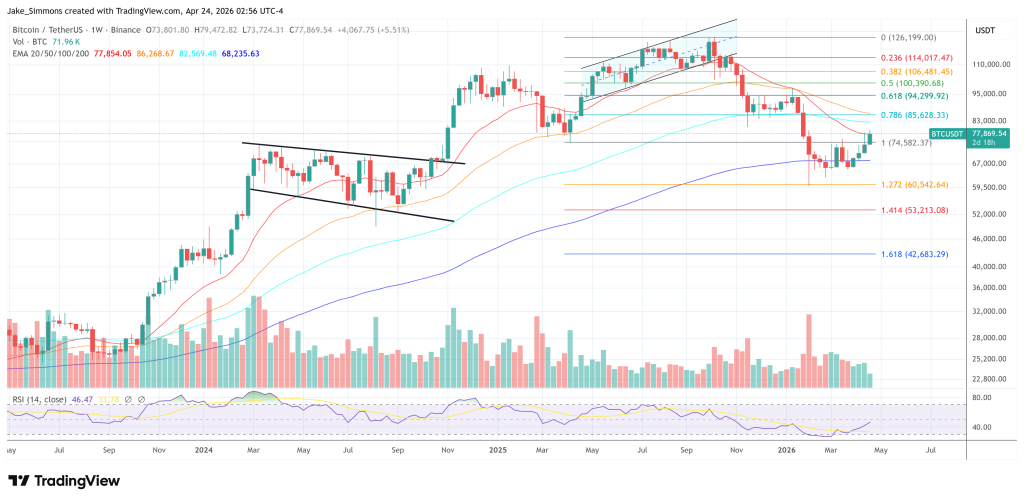
Featured image created with DALL.E, chart from TradingView.com

Editorial Process for bitcoinist is centered on delivering thoroughly researched, accurate, and unbiased content. We uphold strict sourcing standards, and each page undergoes diligent review by our team of top technology experts and seasoned editors. This process ensures the integrity, relevance, and value of our content for our readers.

