


Binance will restrict certain services for users in the European Union (EU) starting July 1, 2026, after the world’s largest crypto exchange failed to secure a MiCA license before the regulation’s transitional period ends. This development comes after Binance withdrew its license application in Greece, stating that user assets remain safe and accessible, and that some EU accounts will be affected depending on their country and account status.
Binance’s MiCA Setback
In an announcement on June 24, Binance confirmed that it had withdrawn its MiCA license application with the Hellenic Capital Market Commission (HCMC), Greece’s capital market regulator. The exchange said the decision was made after considering the progress and timeline of the licensing process in Greece, and stated that it would pursue a license in another EU member state.
Binance has decided to withdraw its MiCA licence application in Greece and pursue authorisation in another EU Member State.
— Binance (@binance) June 24, 2026
Binance emphasized that it had not received a “formal decision” from the Greek regulator as the MiCA transitional period nears its end. Previously, in a June 16 update, the exchange said it had submitted a complete application, worked with the HCMC for months, and understood that the application was being reviewed at the ESMA level following the evaluation process in Greece.
The withdrawal leaves Binance unable to obtain a MiCA license ahead of the July 1, 2026, deadline. Article 143 of Regulation (EU) 2023/1114 allows existing crypto-asset service providers to operate during a transitional period until that date, or until their application is granted or refused, whichever comes first.
As of ESMA’s June 26 update to its MiCA register, Binance does not appear on the list of authorized crypto-asset service providers.
The Financial Times reported that the application in Greece faced hurdles related to anti-money laundering controls and “fit and proper” standards, including the role of founder Changpeng Zhao. Binance did not confirm this characterization and stated it had not received an official decision from the HCMC. Without a MiCA license, Binance will not be able to continue providing its full range of services in the EU as an authorized provider after the deadline.
What EU Users Can Expect
Binance stated it is contacting affected EU users directly and will specify whether individual accounts require action, the available options, the relevant timeline, and support channels. The exchange said user assets remain “safe and secure” and accessible, while warning that Binance will not call to request passwords, 2FA codes, or private keys.
The specific extent of the impact by service and country has not been fully disclosed by Binance. In a June 24 blog post, the exchange only stated that some users could be affected depending on their country and account status, and has not provided an official list of which services will be halted, restricted, or remain active in each EU market.
According to Reuters, the Spanish stock market regulator, CNMV, has ruled out extending the MiCA crypto licensing deadline. Platforms that are not licensed after this deadline will not be allowed to solicit new clients or continue providing regular services, except for activities necessary to reduce or close positions, transfer assets, or support an orderly wind-down process.
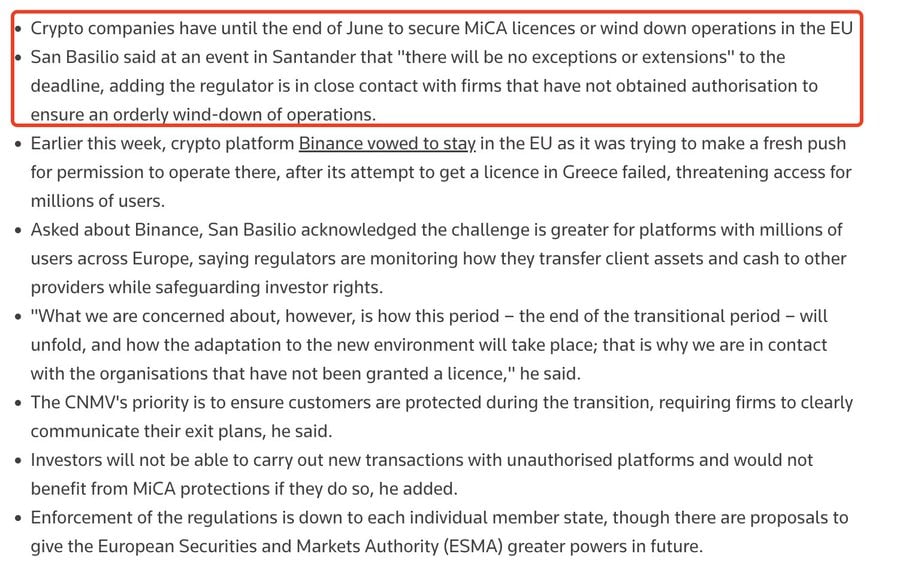
CNMV confirms: “No exceptions or extensions”. Source: Reuters
This means users still need to monitor direct announcements from Binance, as the ability to continue trading, open new positions, use yield-generating products, or access advanced services may vary by country and account status. The scale of affected EU users has not yet been publicly confirmed by Binance.
Why MiCA Matters
MiCA, short for Markets in Crypto-Assets Regulation, is the EU’s common regulatory framework for crypto-assets and related services. The regulation is designed to replace fragmented country-by-country approaches with a more unified system across the bloc.
With a MiCA license, a crypto service provider can use a passporting mechanism to operate in multiple EU countries based on a license granted in a single member state. This is why the Greek application held great significance for Binance: if licensed, the exchange could use that license as a foundation to serve the wider EU market.
MiCA sets requirements for governance, capital, operational controls, user protection, information transparency, technology security, and market abuse prevention. For major exchanges like Binance, the licensing process also places a heavy focus on compliance capacity and the “fit and proper” standards of individuals with significant control or influence.
The compliance issue is a sensitive point in Binance’s track record. In 2023, Binance and Changpeng Zhao, commonly known as CZ, reached a settlement with the U.S. Department of Justice, in which the exchange pleaded guilty and agreed to pay a total of $4.316 billion to resolve allegations related to anti-money laundering violations, unlicensed money transmitting, and sanctions. CZ stepped down as CEO and pleaded guilty to failing to maintain an effective AML program.
In recent updates, Binance stated it now has over 1,500 personnel in compliance roles and has prevented nearly $7 billion in potential losses from fraud. CZ also reacted on X, stating that the EU is cutting users off from the world’s best liquidity pool and arguing that liquidity is a form of consumer protection. This view contrasts with MiCA’s approach, which prioritizes licensing, risk control, and investor protection within a unified legal framework.
What Comes Next
Binance said its commitment to Europe remains unchanged, and the exchange is confident it can secure a license in another EU member state in the coming months. However, Binance has not announced which country it will apply to or pursue.
During the period without a license, affected accounts will need to monitor emails and in-app notifications for specific options. Binance stated it will provide direct guidance if users need to take further steps.
The next points to watch are ESMA’s CASP register, public responses from the HCMC or other national regulators, and any announcements from Binance regarding its new target market for licensing. If granted a license in a member state, Binance can restore its path to serving the broader EU under the MiCA framework.
In the short term, this remains a major setback for Binance in Europe. The exchange insists it is not leaving the region, but missing the MiCA deadline pushes its EU operations into a restricted phase, while already-licensed platforms gain a clearer advantage in continuing to serve users under the new regulatory framework.
