

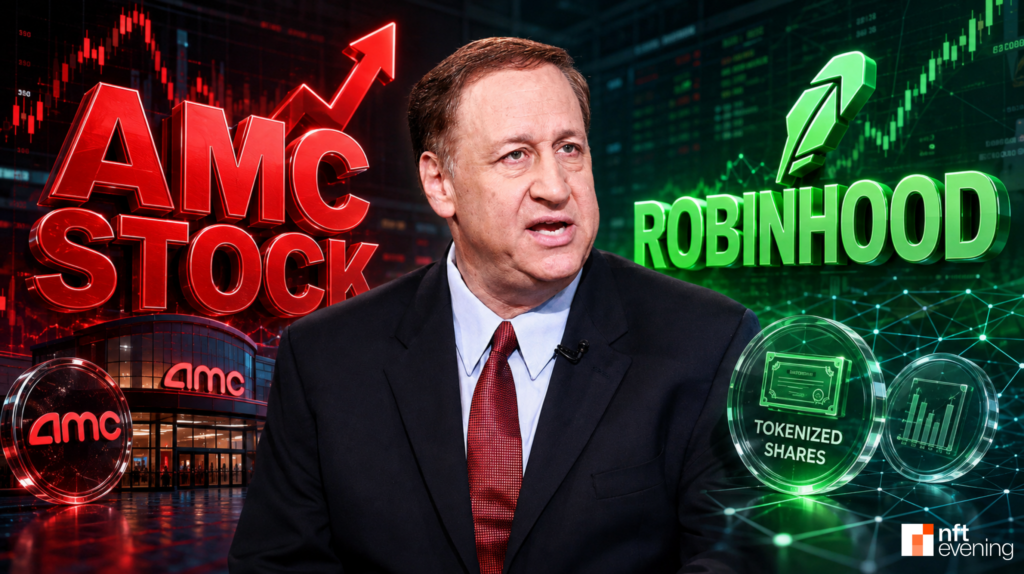
AMC Entertainment stock surged ahead of Friday trading on September 4, 2026, after CEO Adam Aron publicly criticized Robinhood for issuing stock tokens tied to AMC shares without the participation or approval of the theater chain. TradingView data showed AMC briefly rising nearly 21% to $3.07 before Friday’s main session, though gains narrowed as the market entered regular trading. Robinhood shares fell about 2% on the same day. The incident turned a familiar meme-stock rally into a new confrontation between a listed company and the wave of stock tokenization.
AMC CEO Challenges Robinhood’s Stock Tokens
Adam Aron, Chairman and CEO of AMC, objected to Robinhood offering AMC-linked stock tokens through an offshore affiliate. In posts on X, he stated AMC has no connection to the product, does not endorse it, and did not approve the issuance of tokens tied to AMC shares.
These stock tokens are described by Robinhood as unregistered under U.S. securities laws and not intended for U.S. persons, yet they still appeared on the company’s U.S. website. Aron questioned why Robinhood was promoting those offshore tokens if they could not be sold to U.S. investors.
AMC stated it would ask outside securities counsel to review the matter. Aron also called Robinhood’s decision a “terrible lapse in judgment” after CEO Vlad Tenev said the company continues to stand behind the Stock Tokens product.
In my opinion, one that is shared by others, that’s a terrible lapse in your judgement @vladtenev
Playing fast and loose with U.S. securities laws is not something that brings honor to Robinhood. It is not one that adds integrity or credibility to financial markets.
By your… https://t.co/6EIw0tqaeX
— Adam Aron (@CEOAdam) September 4, 2026
Robinhood Says Tokens Are Not Actual Shares
According to Robinhood, its stock tokens are issued by Robinhood Assets (Jersey) Limited in the form of tokenized debt securities. The product gives investors exposure to price movements of the underlying stock or ETF, but does not grant ownership rights in the issuing company.
With tokens tied to AMC, buyers do not become AMC shareholders. They have no voting rights, no right to attend shareholder meetings, and do not appear on the company’s shareholder register. Robinhood stated each circulating stock token is backed 1:1 by the underlying stock, held by a licensed custodian.
These stock tokens are not registered under U.S. securities laws and are not intended for U.S. persons. Robinhood explicitly noted the product is not offered, sold, or transferred in the U.S., or for the account/benefit of U.S. persons. Offers are also restricted in certain other markets, including Canada, the UK, and Switzerland.
Robinhood is currently promoting over 190 stock tokens tied to major stocks and ETFs, including Nvidia, Google, Apple, and Invesco QQQ. The company pitched the product as a way for non-U.S. investors to access the U.S. stock market while being able to trade and use tokens in on-chain applications.
Why Tokenized Stocks Are Drawing Scrutiny
The controversy surrounding AMC comes as tokenized stocks are expanded by various crypto platforms and brokerages. These products allow investors exposure to U.S. stock price fluctuations without necessarily owning actual shares, raising questions about shareholder rights, risk disclosures, and the regulatory scope of securities laws.
A major risk lies in how retail investors understand the product. When tokens are promoted using the names of familiar listed companies, buyers may confuse holding a price-tracking instrument with owning real shares.
Token prices can diverge from the underlying stock when traded outside market hours or on offshore platforms. This risk is higher for tickers with high liquidity, sharp volatility, or heavy influence from speculative sentiment.
According to data from RWA.xyz, tokenized stocks are a distinct asset group monitored within the real-world asset (RWA) tokenization market, with platforms like Ondo, xStocks, Securitize, and Superstate among the largest by total value. While small compared to traditional equity markets, the product’s expansion speed makes regulatory questions around ownership, custody, and investor protection increasingly urgent.
AMC’s Meme-Stock Context
AMC’s rally occurred in a stock accustomed to swinging heavily on news and retail investor sentiment. During 2021-2022, AMC became a key symbol of the meme-stock craze, alongside the rise of online trading communities and commission-free brokerages.
AMC previously leveraged meme-stock momentum to sell additional equity and raise capital, particularly in 2021 when the theater industry faced ongoing pandemic pressure. This background explains why AMC price-tracking products are particularly sensitive for the company, even if token buyers are not actual shareholders.
Latest quarterly results showed AMC’s revenue and EBITDA growing year-over-year. In Q2 2026, the company reported revenue of $1.5967 billion, up 14.2%. Adjusted EBITDA reached $321.4 million, up 69.6%. Cash and cash equivalents as of June 30, 2026, stood at $778.4 million, excluding $41.1 million in restricted cash.
AMC still recorded a net loss of $11.4 million in Q2, compared to a $4.7 million net loss in the prior-year period. Stock price volatility and investor confidence thus remain critical factors for the company.
What Comes Next
AMC has not announced specific legal action beyond stating it will have outside securities counsel review the issue. Key items to watch next are whether the company submits a formal request to regulators, whether Robinhood adjusts how it promotes stock tokens on its U.S. website, and whether AMC-linked tokens continue to be offered through Robinhood’s offshore unit.
The incident also presents Robinhood with a new test for its stock tokenization strategy. In Q2 2026, the company reported net revenue of $1.308 billion, net income of $561 million, and transaction-based revenue of $776 million. Tokenized stocks could help Robinhood expand beyond traditional brokerage operations, but the dispute with AMC shows the product is prone to pushback from listed corporations.
For AMC, this price jump may prove to be a short-term meme-stock fluctuation. The conflict will be watched as a test case for how trading platforms list public equities on the blockchain without the direct involvement of the issuing companies.
