

Key Takeaways
- Hougan identifies Coinbase as a beneficiary of preserved rewards.
- A five-year SEC exemption allows conditional tokenized stock trading.
- Updated buyback guidance requires a network with no central party.
Stablecoin Platforms Preserve Customer Rewards
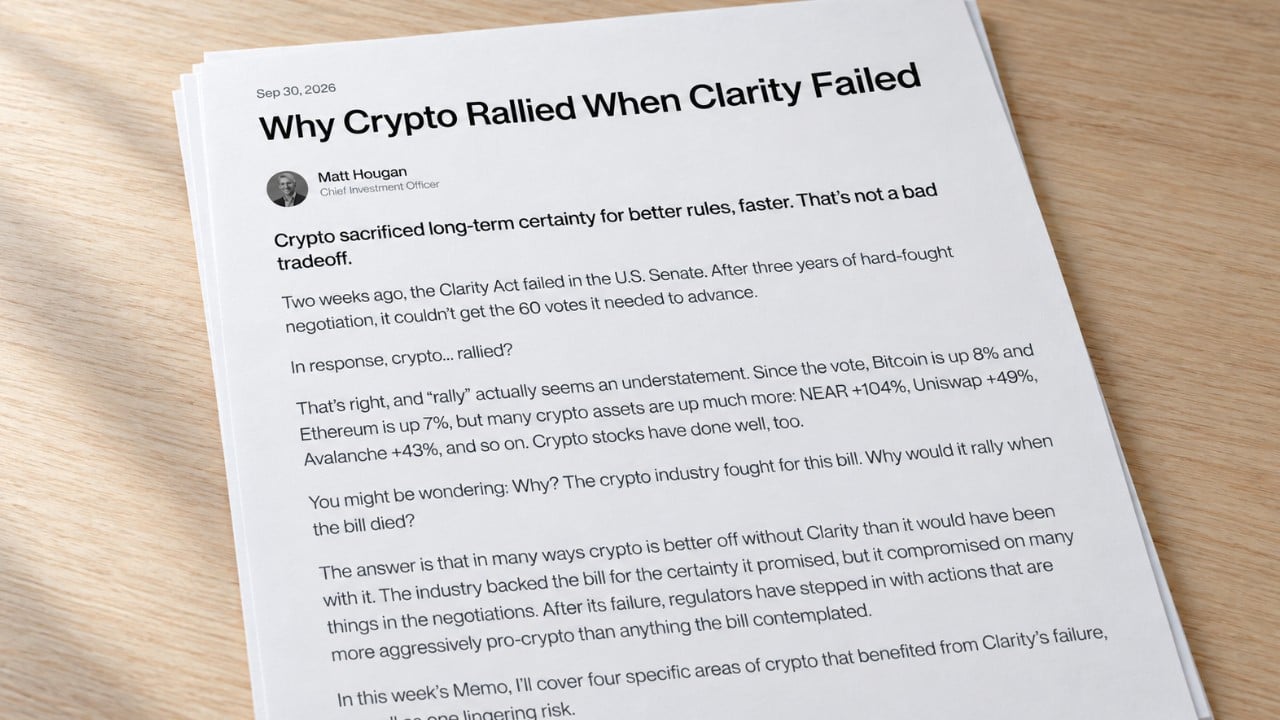
Four areas of crypto gained business advantages after the Senate failed to advance the CLARITY Act in a Sept. 15 procedural vote. Matt Hougan, chief investment officer at Bitwise Asset Management, outlined those benefits in his analysis of four sectors benefiting from CLARITY’s failure published Sept. 30. He wrote:
“Crypto sacrificed long-term certainty and got better rules, faster.”
The first beneficiary was the stablecoin sector, where platforms retained the ability to offer customers rewards on balances. Stablecoins aim to maintain a stable value, commonly linked to the U.S. dollar. The analysis described the bill’s proposed restrictions as a threat to those incentives, with penalties reaching $5 million per violation.
The GENIUS Act provides a separate interest prohibition for issuers, which create and redeem payment stablecoins. Enacted July 18, 2025, its text targets issuer-paid yield tied solely to holding, using, or retaining them. Hougan views third-party incentives as an opening.
Crypto exchange Coinbase (Nasdaq: COIN) uses those incentives to attract customers and has defended stablecoin rewards against bank-style regulation. The analysis identifies it as the largest beneficiary, with banks’ resistance likely helping stablecoins win share from the traditional system.
Crypto Exchanges Keep Licensing and Brokerage Advantages
Established trading operators retained licensing and brokerage advantages that the proposed legislation threatened, according to the analysis. A national licensing framework would have simplified entry for traditional financial companies, he wrote. Coinbase and fellow exchange Kraken instead retain the advantage of securing permissions under the existing state licensing system.
The proposed legislation would also have constrained exchanges’ ability to combine trading venues and brokerage services, Hougan wrote. Venues match trades; brokers handle customer orders. Preserving the combined model avoids the higher costs he associated with those limits.
Tokenization Platforms Gain Permission to Test Stock Trading
Businesses representing financial assets as blockchain tokens gained a testing opportunity through regulatory action, the analysis argues. The Securities and Exchange Commission (SEC) issued its five-year tokenized stock trading exemption Sept. 17. Qualifying venues can use permissioned automated market makers and liquidity pools, which facilitate trades through software and pooled assets for authorized participants.
The temporary relief exempts qualifying venues from the legal definition of an exchange and certain liquidity providers from the definition of a dealer. Stock eligibility and trading-volume restrictions apply. The executive contrasts immediate testing with the bill’s proposed study and rulemaking, which he expected to take years.
Hougan singled out Securitize (NYSE: SECZ), which tokenizes funds for institutions including Blackrock, Apollo, and KKR, as a beneficiary. It also maintains ownership records as transfer agent for Blackrock’s tokenized BUIDL fund.
Token Buybacks Get Guidance With Conditions
Revenue-generating tokens, which use fees earned by their platforms to repurchase supply, formed the fourth category in the analysis. As of Sept. 30, the executive reported post-vote gains of 104% for NEAR, 49% for Uniswap, 19% for Pump, 15% for Hyperliquid, and 10% for Lighter.
The SEC staff’s updated buyback guidance addresses whether repurchase announcements promise work that purchasers rely on for expected profits. For a non-security asset on a functional system with no central party, the announcement would not constitute that promise. Staff added the latter condition Sept. 28; the guidance has no legal force.
The relationship between token buybacks and securities treatment also depends on the network’s stage and how potential returns are presented. For an unfinished system, presenting repurchases as creating yield could constitute such a promise.
Hougan identified one remaining risk: An administration taking office in January 2029 could appoint regulators who adopt a harder line. Growing blockchain involvement by major financial firms makes reversals less likely, in his assessment.
