

Key Takeaways
- The Treasury proposed GENIUS Act rules requiring payment stablecoins to hold US licenses to operate.
- The 87-question consultation seeks public input to gauge the rules’ economic impact and compliance.
- Secretary Bessent says swift rules offer regulatory certainty, cementing America as the crypto capital.
U.S. Department of the Treasury Seeks Input on GENIUS Rules
The U.S. Department of the Treasury is accelerating preparations for the full implementation of the Guiding and Establishing National Innovation for U.S. Stablecoins (GENIUS) Act, which was signed into law on July 18, 2025, and is set to take effect on January 18, 2027.
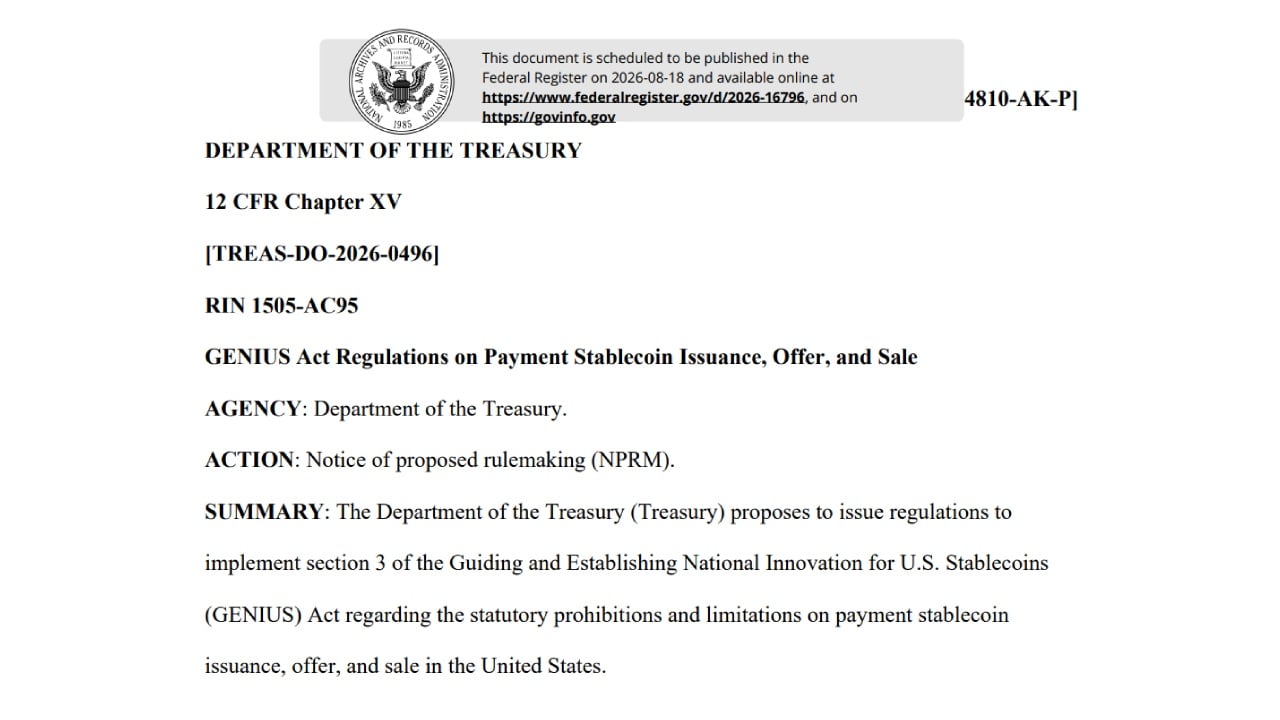
On Monday, the department issued a Notice of Proposed Rulemaking (NPRM) seeking public input on a key GENIUS Act provision that establishes that payment stablecoins cannot be issued without federal or state licenses, and that foreign stablecoin issuers cannot offer their products to U.S. customers if they lack the technological capability to comply with lawful orders coming from U.S. regulators. Service providers would not be able to offer such stablecoins to their customers in the U.S.
The consultation, which remains unpublished at the time of writing and will be published on Tuesday, includes 87 questions asking for feedback regarding the issuance of these stablecoins, the extraterritoriality of the provisions governing them, virtual asset service providers’ compliance, offshore treatment of these tokens, and the economic impact of the proposed rules.
Treasury Secretary Scott Bessent stressed the need to build this ruleset swiftly. “President Trump and Congress delivered the GENIUS Act, establishing a landmark framework and clear rules of the road for payment stablecoins, and Treasury is moving quickly to implement that framework,” he declared.
Members of the public and industry stakeholders will be able to submit comments in response to the NPRM within 60 days of its publication in the Federal Register.
“Treasury welcomes input from stakeholders as we work to provide the regulatory certainty businesses need to innovate and grow in America, cement the role of the U.S. dollar as the world’s reserve currency, and keep America the crypto capital of the world,” Bessent concluded.
This public consultation follows a broader one conducted in September, when the department invited the public to extend comments, including data and other relevant information, for the institution to consider.
