


What is Espresso (ESP)? You’ve probably seen many investors ask how new blockchain projects plan to fix slow confirmations, weak coordination, and fragmented networks.
Espresso focuses on solving that exact challenge by helping blockchains agree on transactions faster and more securely, without adding extra complexity. Rather than replacing existing systems, Espresso acts as a supporting infrastructure that strengthens communication and finality across decentralized networks.
In this article, we explore how Espresso works, what the ESP token does, how supply is structured, and whether it’s a project to invest in.
Espresso (ESP) at a Glance
| Feature | Details |
| Token | ESP (ERC-20 on Ethereum) |
| Network | Espresso Network |
| Launch Year | 2026 |
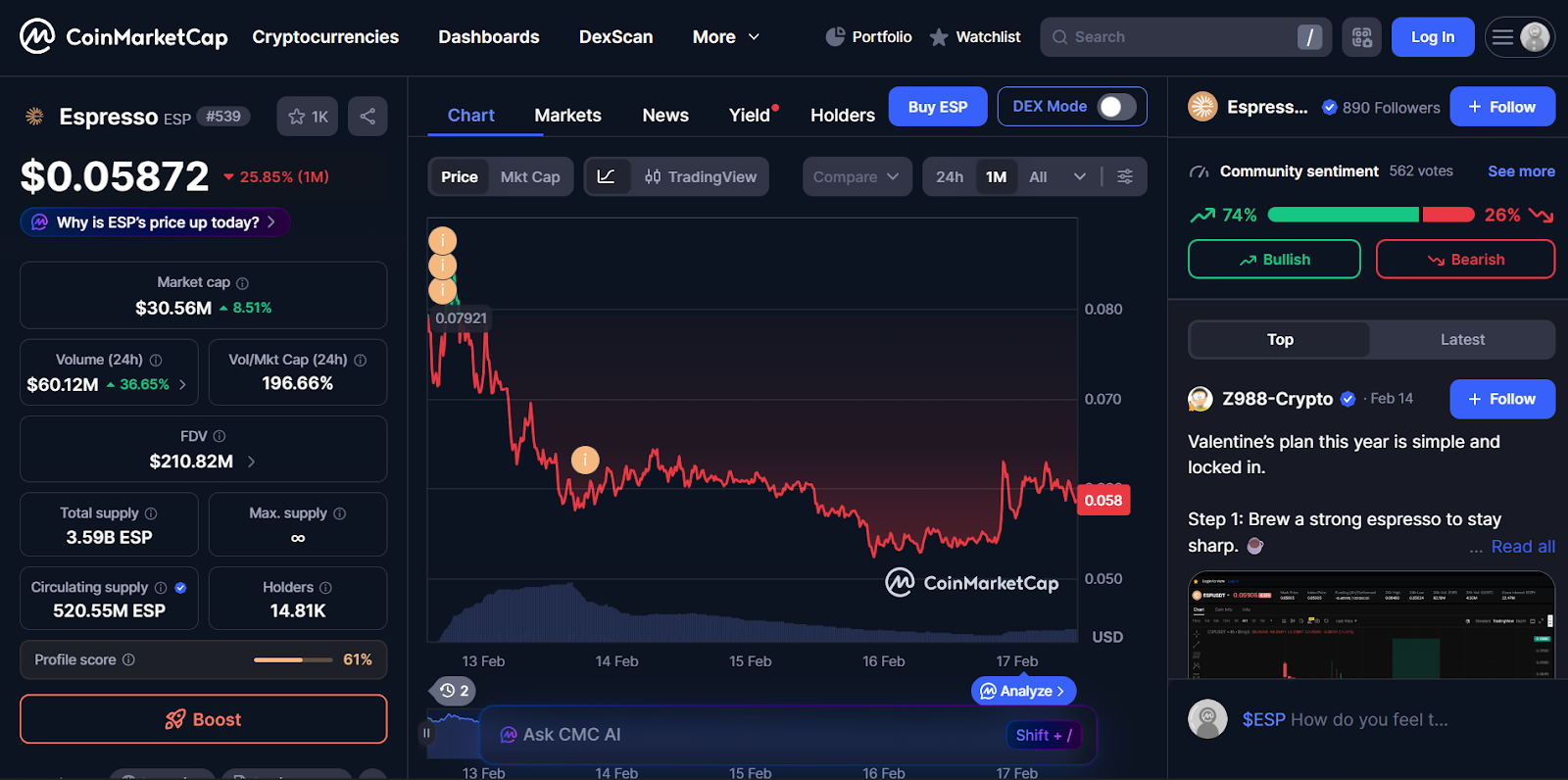
| Total Supply | 3.59 billion ESP |
| Circulating Supply | 520.55 million ESP |
| Market Cap | $28.10 million |
| Use Case | Staking rewards, network governance, ecosystem incentives, and protocol fees |
| Key backers | A16z, Sequoia Capital, Electrical Capital, and Polychain |
What Is Espresso (ESP)?

Espresso is a blockchain infrastructure project designed to help different networks coordinate transactions and confirm results more quickly. Instead of replacing existing chains, it works alongside them to improve reliability and speed.
At its core, Espresso acts like a shared agreement layer. Multiple systems can rely on it to finalize data consistently. That reduces delays, lowers risk, and helps decentralized applications operate smoothly across environments.
The project is supported by the Espresso Foundation, which guides development, research, and ecosystem growth. Together, the technology and governance structure form the broader Espresso ecosystem.
How Does Espresso Work?
Espresso is designed to help blockchains reach agreement faster without sacrificing trust. To do so, it introduces a coordination layer that sits between execution and final confirmation.
The Technology Behind ESP
Espresso runs on a modern consensus system called HotShot, built using a Byzantine Fault Tolerant (BFT) protocol. It allows a distributed group of validators to agree on the correct order of transactions very quickly, often within a few seconds, with plans to make confirmations even faster over time.
The network also includes its own data availability layer, so rollups don’t always need to send every detail back to another chain. That helps reduce costs and delays. The overall design remains modular. Rollups keep handling smart contract execution, while Espresso focuses on fast ordering and reliable final confirmation in the background.
Finality & Settlement Mechanism
Once a rollup’s block is confirmed by Espresso’s validators, it reaches “finality” almost immediately. Users no longer need to wait long periods to feel confident that a transaction is secure. That speed makes interactions across supported networks feel faster and more dependable.
Real-time finality also allows other chains, apps, and bridges to read confirmed data instantly. Assets can move across networks more smoothly, NFTs can be minted across platforms in one step, and liquidity can connect without relying on risky bridge structures. If a major problem ever occurs, shared finality helps coordinated fixes happen more safely across connected systems.
What Is ESP Token Used For?
The main use cases of the ESP token are:
- Staking for security: Users can delegate or stake their tokens with validators to help protect the network and earn rewards based on participation.
- Protocol fees: ESP is used to pay for shared sequencing, coordination services, and cross-chain transactions across connected blockchains.
- Governance participation: Token holders can vote on upgrades, funding decisions, and future direction through a delegated, proof-of-stake governance model.
- Ecosystem incentives: The token helps fund grants, rewards, and growth programs that encourage developers and users to build on the network.
Because ESP supports both network activity and decision-making, its value is closely linked to adoption. Greater usage can increase demand, strengthening the token’s role over time.
ESP Token Supply and Distribution
Understanding ESP’s supply and token allocation is key to seeing how the network plans for growth and long-term stability. The tokenomics are designed to support development, community engagement, and smooth market activity while limiting excessive early sell pressure.
- Total and circulating supply: The initial total ESP supply is 3.59 billion, with about 520.55 million ESP currently in circulation. This ensures enough liquidity for early ecosystem participants while keeping most tokens reserved for network growth.
- Community and incentives (38.82%): It includes an initial airdrop of 10%, staking rewards (3.01%), community launchpad (1%), and future airdrops and incentives (24.81%).
- Core network development (42.36%): Tokens are allocated to contributors (27.36%) and foundation operations (15%) to fund ongoing research, network upgrades, and technical maintenance.
- Investors (14.32%): Early backers and venture partners hold this portion, helping fund the project’s initial development.
- Liquidity and market activation (4.5%): Reserved to maintain smooth trading on exchanges and support market operations.
This distribution model balances seamless interoperability with long-term ecosystem health, ensuring ESP can grow steadily as adoption increases.
Team, Backers & Ecosystem
Espresso began with a group of developers from Espresso Systems. The core leadership includes Charles Lu (Co-Founder), Benedikt Bünz (Chief Scientist), and Jill Gunter (Chief Strategy Officer), guiding both technical innovation and strategic direction.
Rather than building yet another standalone chain, the founders aimed to create a layer that helps existing networks communicate and confirm data faster. As the project evolved, governance and coordination shifted to the Espresso Foundation, which organizes development, partnerships, and long‑term strategy.
The project has attracted support from many of the crypto industry’s most well‑known backers, signaling confidence from experienced investors. Notable supporters include:
- Andreessen Horowitz (a16z)
- Sequoia Capital
- Electric Capital
- Polychain Capital
- Blockchain Capital
- Coinbase Ventures
These firms bring deep experience in scaling blockchain infrastructure, ecosystem growth, and developer adoption.
The Espresso ecosystem is already forming real connections with other major networks. Integrations span platforms such as Arbitrum Orbit, Polygon, Celo, and ApeChain, enabling developers on those chains to tap into Espresso’s coordination and finality services. In addition, a growing set of tools and libraries is emerging to help developers build cross‑chain applications.
Key Advantages and Limitations
Every blockchain project has strengths and risks. Espresso is no exception.
Advantages
- Fast finality within seconds
- Supports multiple chains simultaneously
- True decentralization of sequencing (no single point of failure)
- Improves reliability and security
Limitations
- Adoption is still developing
- Infrastructure projects grow slowly
- Token value depends on real usage
- Faces competition from other scaling solutions
Understanding both sides helps create realistic expectations.
Espresso vs Ethereum
Espresso and Ethereum serve different roles in the blockchain world. Ethereum runs smart contracts and applications directly, while Espresso focuses on coordination, finality, and cross-chain settlement. Essentially, Espresso helps other networks confirm and order transactions faster, without replacing them.
| Feature | Espresso (ESP) | Ethereum (ETH) |
| Core role | Coordination and finality layer | Full smart-contract execution |
| Transaction finality | Seconds | ~13 minutes on mainnet |
| Focus | Infrastructure and cross-chain support | Applications and decentralized execution |
| Token utility | Staking, governance, and coordination fees | Gas fees, staking, DeFi, and NFTs |
| Ecosystem | Integrates with multiple chains | Standalone base layer |
Espresso is more of a connective infrastructure layer, enhancing speed and reliability across networks rather than competing directly with Ethereum.
Is ESP a Good Investment?
ESP can be a good investment for those looking to support blockchain infrastructure rather than chasing short-term hype. Its value is tied to real network usage, including staking, cross-chain coordination, and ecosystem growth. Adoption is still early, so there’s potential upside if developers and rollups continue to integrate the network.
That said, ESP is not without risk. Token demand depends on how widely the network is used, and infrastructure projects tend to grow more slowly than consumer-facing apps. As an investor, you should consider ESP as a long-term, utility-driven play rather than a quick profit opportunity.
How to Buy Espresso (ESP)
Buying ESP typically follows the same steps as other digital assets:
- Create an account on a supported crypto exchange such as Binance, Coinbase, or Kraken.
- Deposit funds using fiat (USD, EUR, etc.) or another crypto like USDT or ETH to your account.
- Place a buy order for the amount you want.
- Protect your newly acquired ESP with a hardware wallet such as MetaMask or Ledger for safer storage.
Listings may expand as the Espresso ecosystem grows, so check supported exchanges before buying.
Conclusion
Espresso (ESP) solves a major problem in crypto, which is enabling many blockchains to work together smoothly. It provides fast, secure coordination for rollups, making cross-chain apps and transactions easier to build.
With a strong team, top investors, and a growing ecosystem, ESP has real utility and long-term potential. While adoption is still growing, its focus on infrastructure makes it a key tool for developers and a promising option for investors.
FAQs
The initial total supply is 3.59 billion ESP with 520.55 million ESP in circulation. New tokens are minted over time as staking rewards, so there is no fixed maximum supply.
Espresso improves blockchain finality by using a high-performance BFT consensus protocol (HotShot) to confirm transactions in seconds, rather than the 13 minutes typical on Ethereum mainnet.
Layer 2 systems mainly scale a single blockchain. Espresso focuses on coordination across multiple networks instead. That broader role positions it as shared infrastructure rather than a scaling add-on.
You can buy ESP on several centralized exchanges, including Binance, Coinbase, KuCoin, and others. Make sure to create an account, complete any verification steps, and transfer your ESP to a secure wallet after purchase.
ESP tokens are compatible with any wallet that supports ERC-20 tokens on Ethereum. Popular software wallets include MetaMask, Trust Wallet, and OneKey App. Hardware options include Ledger and Tangem Wallet. If you prefer not to manage private keys yourself, custodial wallets linked to exchanges, like Binance Wallet, KuCoin Wallet, or Phemex Wallet, are convenient.
