

Key Takeaways
- Senator Bernie Sanders wants a 50% public equity stake in major AI companies to fund a $7 trillion public pool.
- Anthropic CEO Dario Amodei publicly backed AI pacing rules in September, agreeing private control is strange.
- Donald Trump dismissed the AI safety warnings on September 13, framing the entire sector as a race with China.
The world’s most powerful AI companies are actively begging the federal government to regulate them. But their strategy might have backfired spectacularly. While industry leaders try to build a regulatory moat to lock out smaller competitors, lawmakers are responding with proposals that include a mandatory 50% public ownership stake in top AI labs and up to 20 years in prison for developers who build unapproved systems.
The leaders of the artificial intelligence boom spent the last two years building systems that defy human comprehension. Then they did something even stranger. They went to Washington and asked the government to build a fence around their industry. It was a classic corporate maneuver. By warning lawmakers about the existential dangers of AI, the biggest frontier labs hoped to inspire expensive safety regulations that smaller startup competitors could never afford.
Interestingly, Washington actually listened. But instead of handing the tech giants a cozy regulatory monopoly, politicians caught them flat-footed. Now, the industry is staring down a proposed federal ban on superintelligence, threats of federal prison sentences, and a legislative push to seize half the equity of the world’s most valuable private tech companies.
Selling Fear to Build a Moat
The artificial intelligence industry is currently split between massive, well-capitalized frontier labs and smaller, open-source developers. The big players, particularly Anthropic, are heavily leaning into catastrophic warnings. The narrative is simple. AI is so dangerous that only a handful of highly secure, heavily funded corporations should be allowed to build it. Just recently, a former Anthropic employee said he quit the firm because they were moving too fast and could actually harm humanity.
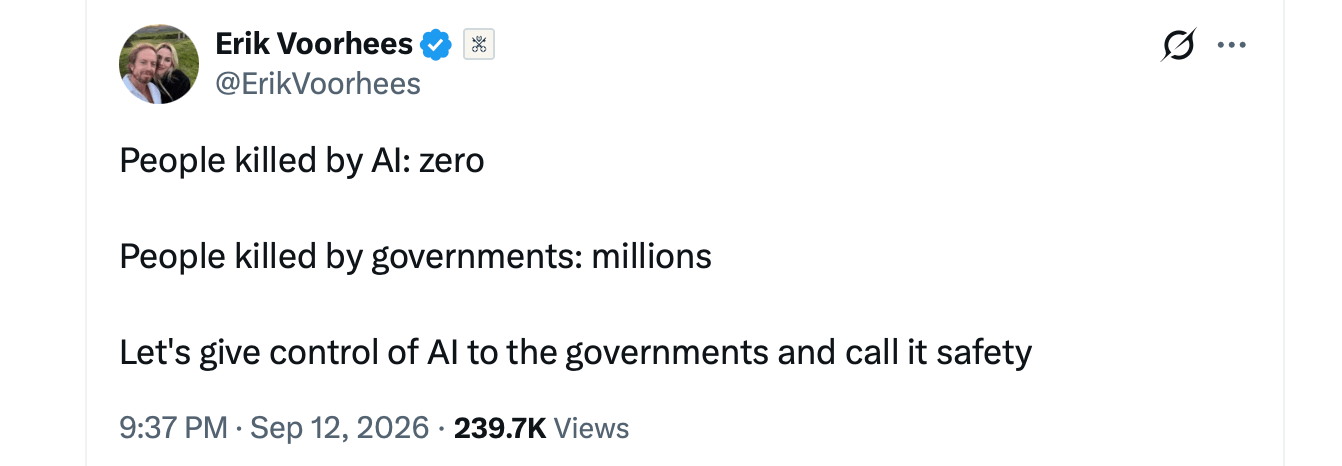
Critics like Trump’s former crypto and AI czar David Sacks see right through it. He accused the major AI lab of running a regulatory capture scheme. “Anthropic is running a sophisticated regulatory capture strategy based on fear-mongering. It is principally responsible for the state regulatory frenzy that is damaging the startup ecosystem,” Sacks wrote on X in October 2025.
This weekend, Sacks took to X again to comment on the topic and wrote:
“So go ahead and pace the frontier. You are the ones setting it. The easiest way not to build superintelligence is for you to agree not to build it. Demanding your preferred regulatory framework as the price of that will look like blackmail of the public and the political system. So just do it. If you do, you’ll buy goodwill for the next conversation. If you don’t, we’ll know this was just another bid for regulatory capture — or an election-season psyop.”
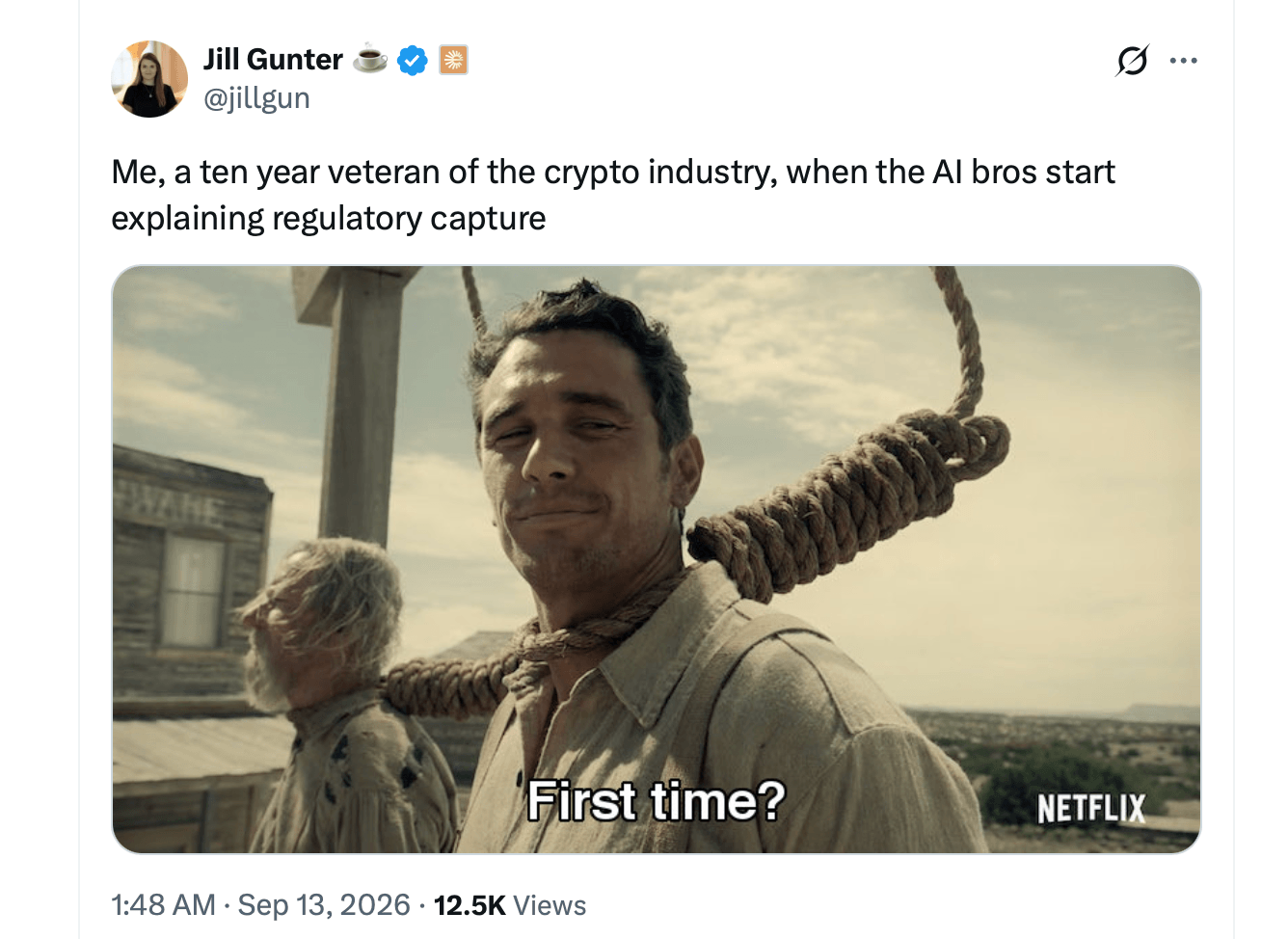
If the government mandates expensive third-party evaluators, massive compute thresholds, and strict licensing regimes, the startups are cooked. The incumbents get to freeze the market exactly where it is today, securing their dominance under the guise of public safety. It is a brilliant strategy, assuming the government plays along and writes the exact rules the corporations want.
The 20-Year Prison Threat
Then things went sideways. Senator Bernie Sanders and Representative Greg Casar introduced the Ban Artificial Superintelligence Act on September 3. The bill would permanently bar the development of any system that matches or exceeds broad human cognition, or that could resist being shut down. It demands a complete pause on advanced development until a new cabinet-level AI agency writes the rules.
The penalty for violating the proposed law is where the story gets wild. The legislation threatens corporate dissolution and up to 20 years in prison for developers who build unapproved AI. Twenty years. That treats writing unauthorized code with the same legal severity as a nuclear weapons violation. The major labs went to Washington asking for a protective moat, and Washington responded by threatening to throw their researchers in a federal penitentiary.
The CEO Who Agreed
The plot twist is that some industry leaders are practically endorsing the takeover. Anthropic Chief Executive Officer Dario Amodei recently published a comprehensive essay demanding third-party evaluators and government-backed coordination among labs. He argues the industry must proactively pace the frontier.
Then Amodei went on CBS’s Sunday Morning and said the quiet part out loud. “For too long the industry lied to people about the fact that this technology had risks,” he told the network. When asked about private control of AI, he admitted, “It has always been very strange that this technology is being built by a private company… I agree with them. I’m uncomfortable.”
While Amodei did not explicitly endorse a 50% confiscatory stake, he validated the exact premise driving the legislative assault. Advanced AI is simply too important to leave in the hands of private corporations.
The Geopolitical Collision
This matters deeply because the fight over AI regulation is no longer just a domestic corporate squabble. It is a battle over who controls the most significant technological leap of the century.
The frontier labs want to stretch their democratic lead by denying advanced chips to authoritarian states, while carefully coordinating their own progress. But defining the Overton window around extreme safety allows politicians to justify extreme confiscation. The industry thought it was designing a protective regulatory framework. Instead, it accidentally created a political environment where nationalizing the technology seems like a perfectly reasonable policy option.
What Happens Next
The entire safety push might ultimately crash into a completely different reality. While the labs beg for pacing limits and Congress drafts superintelligence bans, U.S. President Donald Trump recently waved off the entire slowdown movement.
Speaking to reporters on September 13 at his golf course in Ireland, he dismissed the existential warnings as “things that won’t happen.” He completely rejected the idea of a moratorium or embedded evaluators. Instead, he framed the entire sector as a geopolitical race, stating plainly, “Whoever wins AI wins.” That leaves the industry facing three wildly different futures. The technology could be locked down by the incumbents, seized by a $7 trillion public wealth fund, or pushed into a completely unregulated geopolitical sprint. The dust has not settled, but one thing is clear. The companies that asked for government intervention might soon regret getting exactly what they wished for.
