

Key Takeaways
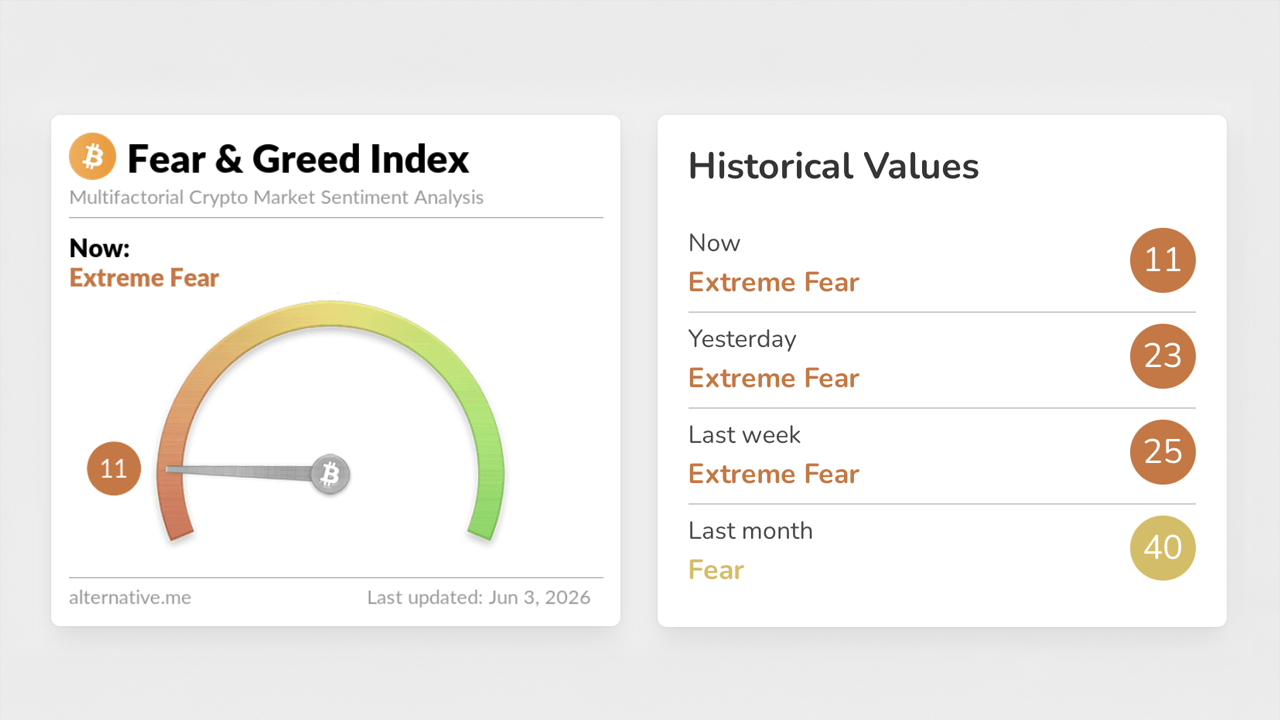
- The Crypto Fear and Greed Index dropped to 11 on June 3, 2026, as bitcoin traded at $65,853 at 1 p.m. EDT, down roughly 47% from its 2025 peak over $126,000.
- Blackrock’s IBIT led U.S. spot bitcoin ETF redemptions, with outflows topping $2 billion across recent sessions and single days exceeding $600 million.
- Traders are watching $65K support closely, with $50K discussed as a potential capitulation floor and the 200-week moving average near $60K to $61K as the next key level.
Fear Takes Over
Bitcoin is down roughly 2 to 3% in the last 24 hours and approximately 8 to 12% over the past week. The broader crypto market fell 2.88% on the day to $2.27 trillion in total market capitalization. Bitcoin’s own market cap accounts for $1.3 trillion of that figure.
The Crypto Fear and Greed Index hosted on alternative.me stood at 23 yesterday, 25 last week, and 40 last month. The one-day drop to 11 marks a sharp acceleration in pessimism across the market. So far, since the all-time high in October 2025, bitcoin’s price has not dropped lower than $59,930 per coin, which occurred on Feb. 5, 2026.
ETF Outflows Drive Institutional De-Risking
U.S. spot bitcoin ETFs have recorded billions in outflows over recent sessions, with some single-day redemptions topping $600 million. Blackrock’s IBIT has been among the leaders in redemptions, reflecting a broader rotation out of crypto and into equities, particularly AI and technology stocks.
The outflows come against a macro backdrop that has grown increasingly unfavorable for risk assets. Stronger-than-expected U.S. jobs data has pushed rate-cut expectations further out, keeping Treasury yields elevated. Geopolitical pressures in the Middle East have also contributed to a risk-off posture among large institutional players.
Leverage Gets Flushed
Over $1.8 billion in leveraged positions were liquidated recently, with long positions absorbing the majority of the damage. Bitcoin has broken several technical support levels during the decline, and bearish chart patterns continue to circulate among traders on social media.
“ BTC WILL DROP TO $50K IN JUNE,” Leshka.eth wrote on X on Wednesday. “ BTC closing second Bear Flag in this cycle $65K is historically strong support, but the data shows how fragile it is. RSI at 37 with room to fall, ETF outflows deepening, and selling volume still heavy – nothing here says bottom. I called the exact top of this bull trap.”
The current price sits roughly 47% below bitcoin’s 2025 peak over $126,000 and is testing support in the $65,000 range. Some analysts are pointing to the $60,000 to $61,000 zone, near the 200-week moving average, as the next meaningful level if $65,000 fails to hold.
The $50,000 Conversation
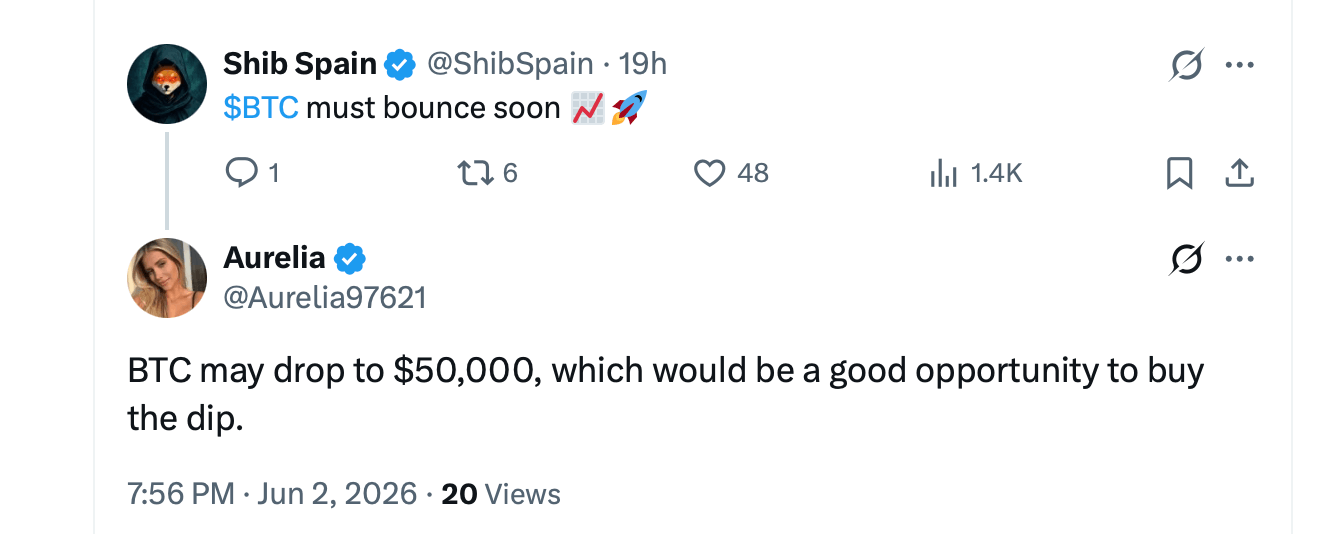
Talk of a $50,000 bitcoin has flooded Crypto Twitter. Some traders frame it as a capitulation zone, the level that historically precedes a recovery. Others are using technical analysis to argue that the current chart structure leaves room for further downside.
“Everybody wanted to buy BTC at $100,000,” the X account Bon Voyage said. “Most will be too scared to buy at $50,000.”
Gold advocate Peter Schiff has been amplifying bearish scenarios publicly. His commentary is consistent with the fear-phase psychology that tends to peak at or near market bottoms, though timing those bottoms remains difficult.
“There is way too much complacency in bitcoin for the market to be anywhere near a bottom,” Schiff wrote on X on Tuesday. “When bitcoin breaks $50K, it should be a quick fall below $20K, which should be a big enough drop to shake the conviction of long-term HODLers, causing many to finally throw in the towel.”
What History Says
Extreme Fear readings below 20 have historically acted as contrarian buy signals over longer timeframes. That does not mean the index cannot fall further or stay depressed, and the current stretch appears more macro-driven than previous fear cycles that were triggered by crypto-specific events.
Long-term holder accumulation data has shown a pattern of divergence from ETF flow noise during prior corrections. Post-halving supply dynamics and growing institutional infrastructure remain in place, though neither factor is preventing short-term price pressure right now.
What Comes Next
These sentiment extremes tend to resolve in one of two ways. Either the macro picture shifts, ETF flows stabilize, and bitcoin finds a floor, or the selling continues until enough participants have exited to remove the overhead pressure entirely. Both outcomes have played out before at similar Fear and Greed readings.
What is clear right now is that the market is deep in a de-risking phase. Retail and leveraged traders are already out, largely by force. The question is whether institutional ETF redemptions have run their course or still have room to go.
The $65,000 level is the line traders are watching most closely in the near term. Below that, $60,000 to $61,000 becomes the next conversation. For patient, longer-horizon holders, readings this low have historically offered better entry conditions than most points in a cycle. That does not make them comfortable. It rarely does.
