

South Korean prosecutors have indicted the group behind CATFI, a meme coin on Solana. This marks the country’s first recorded criminal arrest involving a “rug pull” on a decentralized exchange. The case, handled by the Seoul Southern District Prosecutors’ Office, targets a group accused of issuing, promoting, and manipulating the price of CATFI before dumping the tokens onto the market.
According to local reports, the incident caused damages of approximately 900 million won and is being processed under South Korea’s new virtual asset user protection framework.
How the Alleged Rug Pull Worked
CATFI is a meme coin on Solana, reportedly issued via Pump.fun before trading on DEXs. According to the allegations, the main suspect surnamed Park, known by the alias “Eth Father,” along with his associates, pumped the price of CATFI in a short period and then sold their token holdings to book profits.
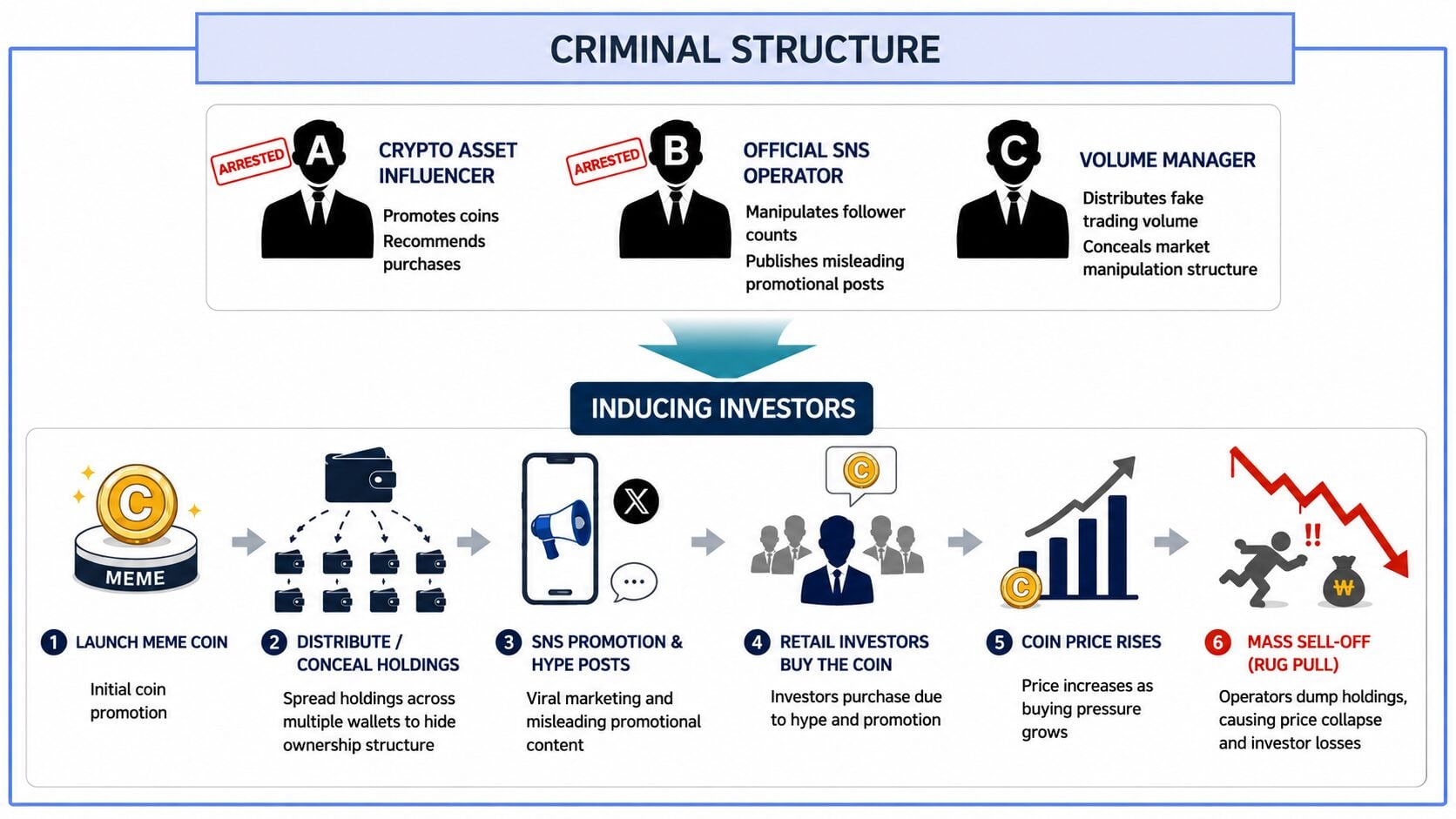
Diagram of criminal structure. Source: Seoul Southern District Prosecutors’ Office
Prosecutors allege that this group not only pulled liquidity from the project but also created fake demand around CATFI before selling off. Park is accused of promoting the token on social media as an independent supporter, while in reality being connected to the issuing group. The group is also alleged to have published false positive information, including claims regarding lock-ups, to attract buyers.
Reports state that CATFI was distributed across multiple wallets to conceal control over the supply, and then wash traded to create fake volume. When the price surged, the group sold their token holdings into the market.
CATFI surged approximately 1,001 times within 26 hours, attracting around 6,000 buyers before crashing. Prosecutors allege that the group used about 10 million won in initial capital to generate approximately 400 million won in illicit profits.
Losses, Victims and Prosecution Details
Currently, 256 investors are recorded as direct victims of the CATFI case, with total damages estimated at around 900 million won. This figure is separate from the roughly 400 million won in illicit profits that prosecutors allege the operating group generated from the token sales.
Regarding legal proceedings, South Korean media reported that two individuals have been arrested and indicted under detention. Another individual was indicted without detention, while two others were indicted on charges of harboring a fugitive.
The individuals in the case are currently still at the alleged or indicted stage and have not been convicted. The case is still in legal proceedings, with charges focusing on market manipulation and fraud on DEXs.
Why It Matters for South Korea’s DeFi Enforcement
The CATFI case is drawing attention because it took place after South Korea brought the Virtual Asset User Protection Act into effect on July 19, 2024. This law allows for the prosecution of unfair trading practices in the virtual asset market, including price manipulation, fraud, and the use of misleading information.
Previously, crypto oversight in South Korea often focused more on centralized exchanges, where regulatory authorities could request user data, order histories, and compliance procedures. CATFI shows that the enforcement direction may expand to DEXs, where trading occurs on-chain but the real identities of the operators are not always clear.
If the case advances further in court, it could set a precedent for how South Korea handles rug pulls on DEXs. Consequently, pulling liquidity or dumping tokens after creating fake demand could be examined under the fraud and unfair trading framework, rather than just being viewed as an investment risk in DeFi.
What the Case Could Mean
The CATFI case could become a test case for how South Korea applies its new virtual asset law to products without centralized intermediaries. If convictions are secured, the CATFI case could help shape how prosecutors prove elements such as supply control, liquidity manipulation, misleading promotion, and connections between on-chain wallets.
This also puts pressure on meme coin promoters. In small-token campaigns, the line between marketing, shilling, and manipulation can be very blurry. But if a KOL or community account actually has financial ties to the issuing group without clear disclosure, that behavior could become evidence for allegations of misleading investors.
For the broader market, the CATFI case shows that DEX activities can still become targets of criminal investigations in South Korea. Even if tokens are launched quickly, traded via anonymous wallets, and spread through social media, investigative agencies can still trace cash flows, supply-controlling wallets, and abnormal trading patterns to build a criminal case.
